
Building a Profitable Neobank by Doing Everything the Hard Way With Ali Niknam, CEO of bunq
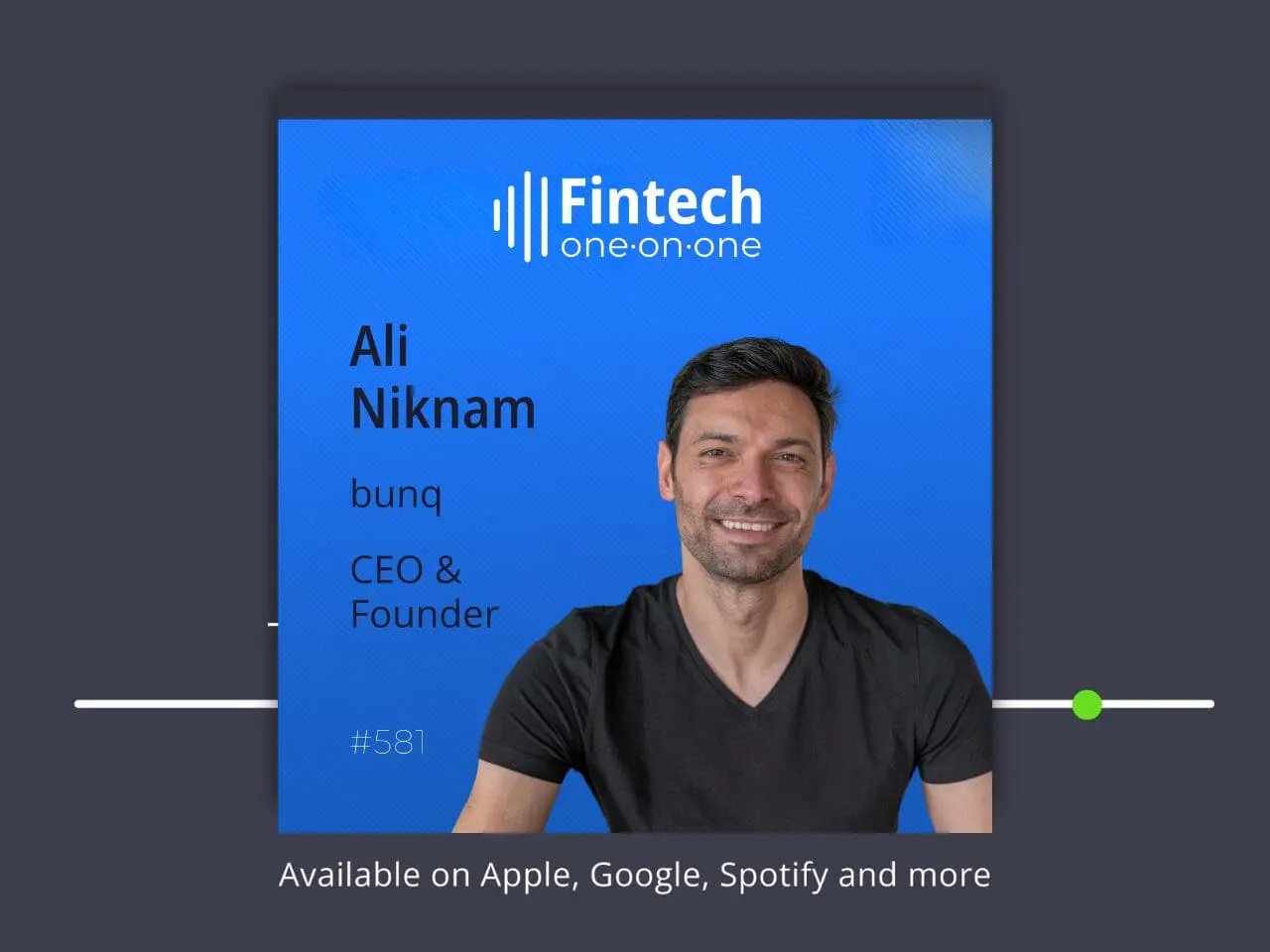
Ali Niknam is one of fintech’s most unconventional founders. He built multiple unicorns before turning his attention to banking, then self-funded bunq with nearly €100 million of his own money before taking a single outside investor. That conviction paid off: bunq posted €85 million in profit in 2024, putting it in rare company among European neobanks. Now, having applied for a US national bank charter, Ali is setting his sights on the most competitive banking market in the world.
What We Covered
- Ali’s background as a three-time unicorn founder
- Self-funding bunq with nearly €100M before taking outside investment
- Pursuing a greenfield banking license, the first granted in the Netherlands in 35 years
- Why bunq launched with a paid subscription model when everyone else was going free
- bunq’s core user base: digital nomads and cross-border travelers
- International expansion across the European Union
- Applying for a US national bank charter and dealing with three regulators
- The philosophy behind building a bank people actually trust for day-to-day use
- How AI powers transaction monitoring, real-time translation, and marketing at bunq
- Why bunq describes itself as the first Gen AI-powered bank
- The personal CFO vision for the future of banking
- What an AI-native bank looks like five years from now
Key Takeaways
Starting with a paid subscription meant bunq only attracted users who genuinely valued the product, building real engagement rather than vanity metrics, and better unit economics from the outset.
Pursuing a full greenfield banking license from the start, while far harder than working around incumbents, lets bunq compete directly with the largest banks on equal regulatory footing.
AI at bunq isn’t a marketing term. It powers transaction monitoring, real-time multilingual customer support, and marketing automation in ways that materially reduce costs and improve security.
The vision for the AI-native bank is a personal CFO that makes abstract financial goals tangible, connecting daily spending habits to the things users actually want in their lives.
About Ali Niknam
Ali Niknam is the founder and CEO of bunq, the Dutch neobank. A serial entrepreneur with three unicorns to his name, Ali was born in Canada to Iranian parents and has been based in the Netherlands for most of his life. Before bunq, he founded TransIP, now rebranded as Team Blue, the world’s third-largest domain name and web hosting provider. He is also the author of a book on entrepreneurship.
Transcription
Ali Niknam (00:10)
Contrary to many of our peers, we didn’t have a free subscription plan. At the time, we started with a paid plan, which meant that people only used us who actually thought, “Okay, this is useful, I need it.” I mean, you can hand out free stuff all day, every day — it doesn’t mean somebody actually appreciates the product. And in doing so, we put ourselves to the ultimate scrutiny of our end users. And through that process, a company was created that on the one hand creates a product that our users love to use, and on the other hand has the financial sanity to be profitable and therefore durable.
Peter (00:46)
This is the Fintech One-on-One podcast, the show for fintech enthusiasts looking to better understand the leaders shaping fintech and banking today. My name is Peter Renton, and since 2013 I’ve been conducting in-depth interviews with fintech founders and banking executives. My guest today is Ali Niknam, the founder and CEO of bunq, the Dutch neobank that is now expanding into the US. Ali is something of a serial entrepreneur. He’s got three unicorns under his belt, but bunq may be his most ambitious project yet. Founded in 2015, bunq took the unusual path of pursuing a full greenfield banking license right from the start — the first company to receive one in the Netherlands in 35 years. Even more unusually, Ali self-funded the company to the tune of nearly 100 million euros of his own money before taking a single outside investor. That kind of conviction has paid off. bunq posted a profit of 85 million euros in 2024, putting it in rare company among European neobanks. Now Ali has his sights set on the US, having applied for a national bank charter earlier this year. We talk about what drove that decision, why bunq is describing itself as the first Gen AI-powered bank, and what it actually means to build a bank with AI baked into its architecture from day one. We also get into his philosophy on profitability, why he started with a paid subscription model when everyone else was going free, and what the personal CFO of the future might look like. Now let’s get on with the show.
Peter (02:28)
Welcome to the podcast, Ali.
Ali (02:30)
Thank you for having me, Peter.
Peter (02:32)
My pleasure. So let’s kick it off by giving the listeners some background. I believe bunq is not your first rodeo. Tell us a little bit about what you’ve done in your career to date.
Ali (02:44)
I was born in Canada, Iranian parents. I lived in Canada, I lived in Iran for a couple of years when I was very young, and I’ve been living in the Netherlands — in the city of Gouda. Gouda, the cheese. It’s a city actually, a lot of people don’t appreciate that, but it’s the cheesy one. It’s a city in the Netherlands. And apparently — I don’t remember it myself — but apparently I started disassembling phones, like the old phones with the rotary dial and the horn and everything, at the age of two. I started coding at the age of nine. I started investing in stocks at the age of 12. Had my first business at the age of 16, first big successful business at the age of 21. Now I have, I think, three unicorns under my belt, and I wrote a book.
Peter (03:30)
Okay, so let’s talk about bunq. I read that you self-funded bunq — nearly 100 million euros of your own money — before taking a single outside investor. I’m curious: that’s not a typical path for a fintech, particularly a neobank. What was the conviction behind that decision? And why did you not want to take VC money when everybody else was doing that?
Ali (03:56)
That’s a great question. So the start of bunq is actually the end days of my previous company, TransIP — today called Team Blue. It’s the world’s third-largest domain name and web hosting provider. And that was doing really well. We had a lot of great talent there, and I wanted to give them space to grow further and make the company even better, which they did. So hats off to that. But then I was left with a lot of time for myself, and I figured it was too early for me to retire — I had a lot of energy in me, I wanted to do more. And to figure out what I wanted to do, I started writing the book I just mentioned in the intro. And the book is about entrepreneurship and all my experiences and all the things I came across. While writing the book, which was one of my lifelong dreams, I came to the conclusion that what really drives me is two things: building products that people love to use, and trying to leave this world behind in a slightly better shape than I found it. And so once that was clear, it was also clear to me that I would at least try to start another company and I wouldn’t bugger off and buy a big boat and do those kinds of things. In hindsight, that may have been the better option of the two, but anyway. So I started looking around, trying to find a company where I could make a difference. And given that the financial crisis was going on at the time and the profound impact it had on society, on everyday life for normal people, I figured, okay, let’s try to make the financial sector different — better, more user-centric. So that was the starting point. And so when we started, we wanted two things: one, a laser focus on users and making a product they love to use, and two, to do it in such a way that we help society forward. And so to have that laser focus, and having the benefit of having had other successful companies, I just invested literally every dime I had in the new company. And that’s how we came about.
Peter (06:16)
So how do you describe bunq today? What do you guys do?
Ali (06:19)
I think what we have done very successfully is a number of things. First of all, by and large, we live by this conviction that we do everything for our users. And so we have created a banking platform that genuinely makes life easy. There are a lot of complex financial products out there that are just too complex for many people to benefit from — such as investing in the stock market. We all know it’s probably good for us in the long term, but I know so many people who are put off by it because it’s too complicated or they can’t find the time. We spend a lot of time making those kinds of things accessible for everyone. And I think we have succeeded at that. bunq is one of the very, very few neobanks that is actually used for day-to-day banking. People trust us. People enjoy using our app. And we’re very proud of that. We do everything we can to expand on that.
The second thing we have done — I think throughout the financial crisis and also in the many years after — is consistently chosen the point of view of consumers and the common good. And so we became the first company to get a greenfield banking permit in 35 years. In doing so, we opened the door for others to also apply for a banking permit. A lot of the rules and regulations that you now see in the European banking sector are a consequence of the process that we went through together with the Dutch Central Bank. We came up with these ideas on how companies can be allowed into the financial market in a safe way. And our presence has objectively spurred innovation. The old-fashioned incumbent banks that were very traditional didn’t really have any competition — their apps were kind of mediocre and they weren’t doing anything. Thanks to our presence on the scene, they started innovating again. And you can see that in the number of deploys and number of features they had. Also, we’re really efficient and effective, so we’re very competitive. And you can see in the Dutch market that ever since we entered, savings rates have gone up and mortgage rates have gone down. That’s because for the first time in a very, very long time, there’s true competition in the financial sector.
Peter (08:51)
I just want to go back to that banking license piece, because I think it’s really important. 35 years without anyone getting a banking license — we thought it was bad in the US, but it wasn’t that bad. Why did you put yourself through that in the early days of bunq?
Ali (09:07)
Just to be very precise — we’re the first in 35 years for a greenfield permit. There had been other banking licenses granted to existing banks, subsidiaries of existing banks, things like that. But greenfield means you’re a new company, you don’t have any existing license, you’re not a subsidiary of an existing bank, and you apply for a banking license and get it granted. That was the unique bit. Because giving a Dutch banking license to, for example, JPMorgan — I’m not saying that happened — but that is a completely different process than having a startup with 30 or 35 people in a bunch of t-shirts and telling them, “Hey, sure, go play with other people’s money.” So you can imagine that process was very, very different. That hadn’t happened for 35 years. And you can imagine that in those 35 years, the rules and regulations have vastly increased in complexity and number. So that was a very significant moment.
Peter (10:07)
You launched, I believe, in 2015. I read that it was described as the WhatsApp for banking. How did you view it when you got that banking license and launched? Did you see yourselves as an IT company with a banking license? And how did you feel the traditional banks viewed you?
Ali (10:24)
Well, I remember at the time, traditional banks were very scared because they just weren’t used to competition from new players — because there had been none. And I know there were attempts from some of the big banks to try and enter our office to figure out what we were working on, even back then. Yeah, that was something out of a spy movie. That was interesting.
We called ourselves an IT company with a banking license just to signify that we were there to make tools to make life easy for our users. Because I believe that’s what tech companies do: they simplify a complicated problem into something understandable and usable by many, or they make things affordable for the masses. It was from that ideology and that vision that we wanted to break through these old banking patterns that seemed to revolve mostly around the banks themselves rather than their customers. And that’s what we set out to do, which is also the reason — to come back to your previous question — why we went through the masochistic process of applying for a banking permit from the start. Because of course we’re a commercial company, and of course we want to make a profit and be financially healthy — also because we want to be durable. But for us, we want to really try and change the world to be more consumer-centric, more user-centric.
Peter (12:04)
So who are the users? Who’s attracted to bunq?
Ali (12:07)
Man, we have so many these days. I think we have a lot of people with what we call a digital nomad background. These are people who live in one country and work in another, or people who travel a lot, or people who maybe have a relationship elsewhere — people who have a holiday home somewhere. In the Netherlands, the weather is usually kind of mediocre — I don’t know where you’re dialing in from, but the Netherlands is always rainy — so it’s not uncommon for a lot of people to have a holiday home somewhere else. In Europe, as soon as you cross the border, you end up with some complexity around having different bank accounts, and so on. All of those things bunq simplifies. If you want to set up a joint account with your partner but you don’t have time to go to the bank with the two of you to sign documents, you can use bunq — set up a joint account in five minutes. If you’re a happy new parent and you want a savings account for your baby, you can set it up in five minutes. And you can do all of that with a hundred percent control in the palm of your hand through the app. You don’t need people. You don’t need to wait for opening times. We put all that power, all that control, all that efficiency in your hand in a very easy way.
Peter (13:33)
So let’s talk about international expansion. The Netherlands is part of the European Union — I presume you took advantage of that. When did you move beyond the Netherlands?
Ali (13:41)
I’ve always been a very strong proponent of Europe. As times have changed — I’m old now, so that gives me the benefit of a historical perspective — people were in favor of the European Union, then they weren’t, then they were again, then there was Brexit, and then other people thought maybe we should exit too. And now with all the sadness going on in the world, a lot of people are thinking maybe the European Union is not a bad idea, maybe we should do more together.
I’ve always been a proponent because ultimately I believe larger groups of people coming together reduces friction, reduces overhead, reduces bureaucracy, and is just a better deal for consumers. The banking union has been one of the things Europe has tried to set out and unify. It’s been a mixed success. So yes, with a European banking permit you can go into all of the European countries — but the success is mixed because there’s still so much country-specific regulation. As a consequence, the European market is not truly harmonized and not truly unified, at the expense of consumers, of course.
Peter (14:54)
Okay, so then you’re now going across the pond, expanding into the US. You talked about how it’s not easy to go into other countries in Europe. Coming to the US is a different level of complexity entirely, as I’m sure you’re very well aware. But why come to the US? Lots of UK digital banks have come here with mixed success. Why is bunq coming? What’s the population you’re wanting to serve?
Ali (15:20)
That’s a great question. Everything we do is basically inspired, or even dictated, by what our users want and what our users do. As we just talked about, we focus all of our efforts on the digital nomads — people for whom borders seem outdated and a bit old-fashioned. People who maybe live in Amsterdam and love to visit New York. People who are in New York and love to go to Paris. Those kinds of people.
Because we have been very successful in attracting those people to our platform, we can then see what areas they go to. The biggest area outside of the EU where our users reside, interact with, do business with, travel to, live in, or come from — is the US. And so for us, following our users, we ended up in the US.
Peter (16:19)
Tell us a little bit about the journey of pursuing a US banking license. I mean, it’s easier these days under the current administration, but it’s still not easy. Tell us a little bit about your journey there.
Ali (16:34)
Doing a bank license application anywhere on this planet is a challenge. It is just mind-boggling how many rules and regulations have been created over the last decades. All of these rules and regulations by themselves make sense because they’re all a consequence of a mishap or a mistake, and they’re all trying to prevent that from happening again. But looking at the totality of all these rules and regulations, the consequence is that you effectively end up with just a handful of gigantic players who are compliance machines. As a result, their service is not necessarily user-oriented or consumer-friendly. That’s my personal generic opinion on the rules and regulations. At the same time, bunq is a fully regulated, fully safe, fully trusted bank — and so we, of course, comply with all of the rules and regulations.
Coming into the US, that meant going back and doing our homework again, as we did in the Netherlands many years ago — looking through all those documents and all those pages and trying to comply with everything. The US is slightly more complex than Europe because we need to deal with three regulators: the OCC, the FDIC, and the Fed. But at the same time, it’s also less complex than Europe because it’s a single jurisdiction, single denomination, single law book kind of thing. So if you look at the application itself, yes — but if you look at the totality of being able to serve the entirety of the US, it’s probably more effective.
Peter (18:18)
Others have come and gotten a banking license after they’ve already established themselves here. What was your thinking in getting this done at the very beginning?
Ali (18:25)
We’re basically copying our playbook from the Netherlands, because there it was the same at the time. Some of our competition started with a lighter license or a simpler license, made some revenue, got some users — which they could then show their investors or potential investors — allowing them to raise capital, and then ultimately apply for a banking permit. But our journey has been different, and our history has been different. For us, that focus on our users on the one hand, and changing things fundamentally on the other, is such a strong conviction that — especially in these big geographies like Europe and the US — we want to have the banking permit. We want to be able to compete head-on with JPMorgan. We want to be able to offer services that comply with all the rules and regulations and have the same safety and security level as a traditional incumbent bank, while giving you an experience that is not stuck in the 1980s.
Peter (19:29)
Okay, I want to talk about profitability, because I read that you made a profit of 85 million euros in 2024, a good result. Lots of neobanks are not making money still. What have you done differently to the others, particularly in Europe, where you’re making profits where others are still struggling?
Ali (19:57)
Well, you know — let’s go Dutch. The Dutch are very good at money management. Though all kidding aside, I think I’m a little bit of an old-fashioned founder. When I started with my first company — which is now, my goodness, 28 years ago — we didn’t have all the fancy VC and private equity and all these other things. I ended up using some money I had saved up to fund that first company, and for my first big company I used a student loan that was supposed to be for my studies. That creates a totally different type of entrepreneur. From a very young age, I learned to appreciate the importance of building a company that is durable on the one hand, and as a consequence, building products that actually add value to someone. Value has a very specific definition: you create something that somebody else says, “I’m willing to pay for this because this solves a problem for me, or this is worth something to me.”
And I think for better or worse, that’s how we started bunq. Contrary to many of our peers, we didn’t have a free subscription plan. At the time, we started with a paid plan, which meant that people only used us who actually thought, “Okay, this is useful, I need it.” Because once you put a price on something, it’s worth something, right? Free — you can hand out free stuff all day, every day, it doesn’t mean somebody actually appreciates the product. And in doing so, we put ourselves to the ultimate scrutiny of our end users. And through that process, a company was created that on the one hand creates a product that our users love to use, and on the other hand has the financial sanity to be profitable and therefore durable. It’s important for a bank to be something consumers can rely on — that they’re going to be around next year and the year after. And I think that’s one of the things we do really well at bunq.
Peter (22:09)
Okay, so I want to talk about AI. We haven’t mentioned it yet. I’ve seen that you’ve described yourself as the first Gen AI-powered bank. You say you’ve got proprietary AI powering every part of your business — user-facing features and internal operations. What does AI-native actually mean?
Ali (22:33)
A lot. I mean, I know AI has become this hyped term that’s stuck on everything these days. The other day I was looking for a washing machine and supposedly washing machines have AI now. I don’t know what that means. But at bunq, because we have the benefit of a new platform that we created in-house from scratch, it allows us to build an architecture where security is embedded inherently — keeping your data and your money extra safe compared to the old guys who are still running on COBOL from the 1960s. But it also enabled us — we were very lucky to have another Ali on our team, “Ali 2” as we call him. He was at the forefront of AI and made sure that our infrastructure and architecture could already support AI. And so as these new technologies became available, we were the first to use AI for transaction monitoring, which helps detect bad people doing bad things and keeps your money safe. We were very advanced in that, and we still use it to this day.
And as Gen AI became available, we started using that in every possible way you can imagine. Behind the scenes, we use it for our marketing activities — instead of having 200 people doing banners and ad campaigns and everything else, we just have a couple of agents creating these things in 38 different languages across all the environments we’re in. But I think more excitingly, on the front-facing side, you have the benefit of being able to use the app in any language your phone supports — which I think is unique, because we deal with a lot of international people. And you can ask your personal assistant, Finn, questions like, “What is my favorite restaurant?” or “What did I spend all my money on?” So we do budgeting and things like that. AI really touches everything we do within bunq. And I think it’s because as a bunch of engineers, it’s a technology and a tool we can use to make life easy for our users — rather than a hyped term stuck on washing machines because somebody said AI is cool.
Peter (24:47)
I’m curious to know — have you actually been able to hire fewer people? I haven’t read about layoffs. Is it really a revenue driver, a cost reduction tool, or a bit of everything?
Ali (25:00)
It’s a number of things. First of all, given the unique situation we’re in, we don’t need to use AI superficially just to make people think we’re worth an investment or whatever. We only use AI if it actually does something for us. And the things it does are: in the security field, it really is more effective than old-fashioned rule-based systems. It’s far more efficient, quicker, more effective, more granular, more precise. So as a user, you have a huge benefit in that your money is extra, extra safe. That’s one.
Two, in terms of efficiency — whatever the AI does, a human doesn’t need to, which allows our people to automate repetitive tasks through AI that in the old days you would still need people to do. So this allows them to think like an architect on problems and solve them once and solve them properly, rather than being on a factory line doing the same thing all day, every day.
The third thing is that because it’s machines, we can do things that humans simply cannot do. For example, if you’re on a call with us, we can do real-time translations — whatever language you’re speaking, whatever language the agent is speaking, they can help you and answer in their language and it gets translated to your language, all happening in real time through a secure end-to-end encrypted line. So I think it touches everything: it’s more effective, it allows us to do things that would otherwise be impossible, and yes, it’s also a cost saver.
Peter (26:51)
So I want to close with a forward-looking question, carrying on from what we’ve just been talking about. Where do you see the frontier moving? What does bunq or an AI-native bank look like five years from now?
Ali (27:09)
To answer that question — if it were an unregulated environment, I could give a cleaner vision. But it isn’t. So a huge part of what’s actually going to happen depends on what the rules and regulations allow. And those move very slowly. So I think five years from now will look very much like today, fortunately or unfortunately. I think AI will be used for more security things. The big banks will run some cost-saving programs, and that will be mostly it.
But you will have a player like bunq who always tries to champion the user and make life easy for them. And I think we’ll be pushing the boundaries of what’s technically possible and legally allowed, in the best service of our users. You can imagine having your personal CFO who helps you manage your money and says, “Hey Peter, you’ve been at McDonald’s for the sixth time this week — maybe grab a sandwich from home.” Or, “Hey Peter, did you know that if you don’t spend 200 bucks on Starbucks every month, in one year you can buy that surfboard you really wanted?” So that’s something bunq can really do: take something as abstract as money — and we all know we need to save, we all know we need to put money aside — and make it tangible, and therefore fun and achievable, in connection with the things we actually want to do as human beings.
Peter (28:49)
That’s a good place to leave it, Ali. I really appreciate you coming on the show today. Best of luck on your US venture, and thanks so much for coming on the show.
Ali (28:58)
It was a pleasure, thank you so much for having me.
Peter (29:06)
There is a lot you can do differently when you can bootstrap your digital bank with more than $100 million of your own money. Ali’s point about starting with a paid subscription model from day one — when every other neobank was racing to acquire free users — is genuinely contrarian, and not something I’d expect a VC-funded digital bank would have considered. As Ali said, you can hand out free stuff all day every day, it doesn’t mean somebody actually appreciates the product. It also means you get better unit economics from day one, which is demonstrated by the 85 million euro profit that bunq made in 2024. It’s going to be fascinating to see, as they tackle the US market, the most competitive market in the world, whether bunq’s contrarian approach will be the one to break through and become the first international digital bank to build a profitable business here. I’m not betting against them. Anyway, that’s it for today’s show. If you enjoy these episodes, please go ahead and subscribe, tell a friend, or leave a review. Thanks so much for listening.


