
The Case for AI as a Revenue Driver in Financial Infrastructure with Chris Walters, CEO of Finastra
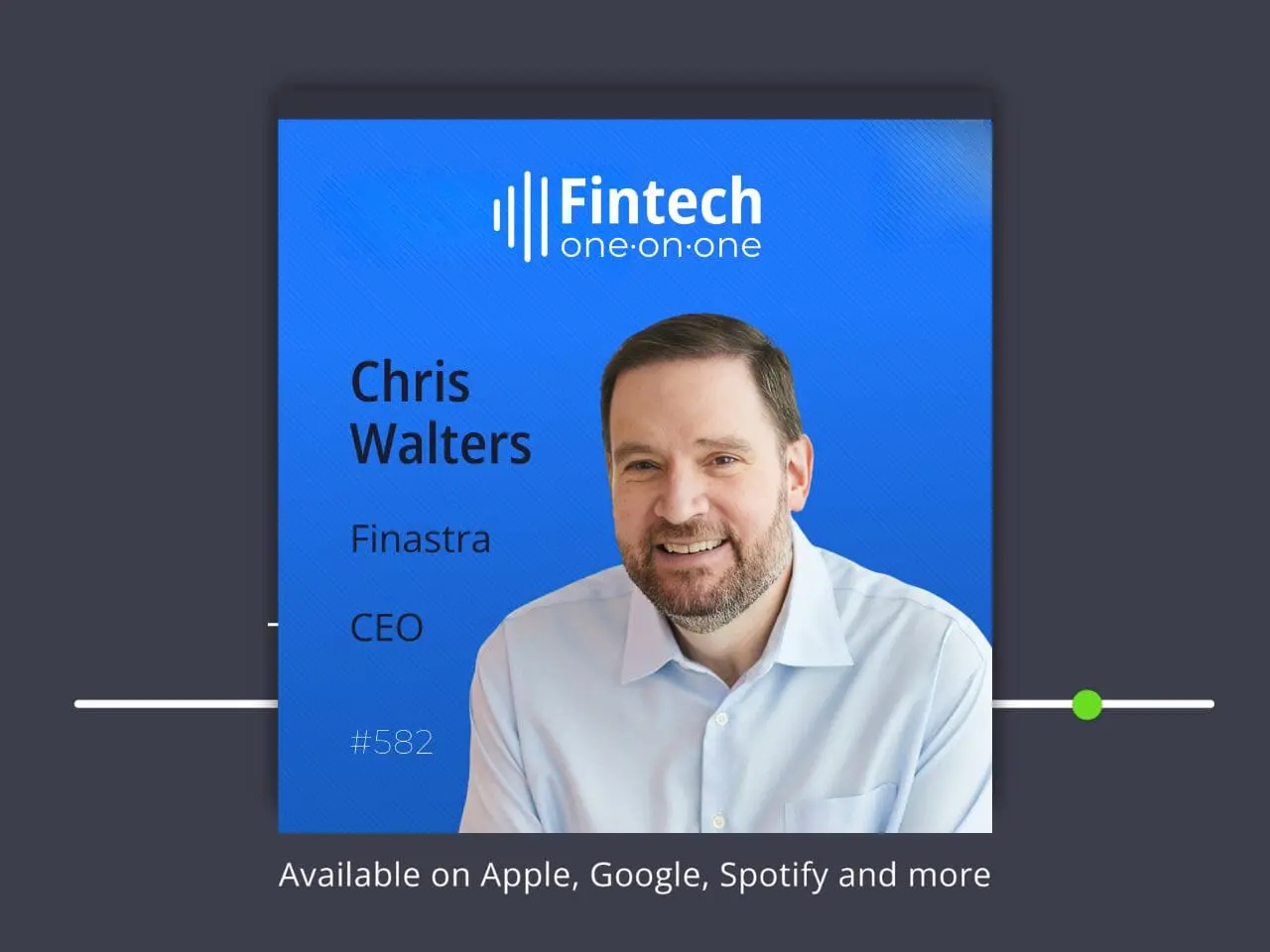
Chris Walters is the CEO of Finastra, one of the largest financial software companies in the world, serving over 7,000 banks globally including 45 of the world’s top 50. He joined the company a little over a year ago, bringing an unusually broad background spanning consulting, Bloomberg, The Weather Company, and several other technology businesses. This is a wide-ranging conversation about where Finastra is headed and why the conventional narrative around AI and software disruption misses something important.
What We Covered
- Chris’s path from consulting to Bloomberg, The Weather Company, and beyond
- What attracted him to Finastra and the perception versus reality gap he set out to close
- How he spent his first 90 days listening to customers and internal teams before deciding direction
- The portfolio narrowing strategy, including divestitures of Treasury, Capital Markets, and student lending
- Finastra’s core focus areas: lending, payments, and universal banking
- Growth vectors within an existing base of 7,000+ banks, including geography expansion, cross-sell, and data
- The AI center of excellence and why dedicated ownership changes the pace of deployment
- Internal AI use cases: an HR chatbot and automated sales approvals
- Operator Assist, a new product that uses AI to surface and resolve failed payments
- Agentic AI in mortgage origination, targeting documentation discrepancies
- Why Finastra views AI as a growth accelerant, not a cost-cutting tool, and why not all software faces the same disruption risk
- Community bank caution around modernization and why the economics will eventually force full core replacements
Key Takeaways
Companies that are systems of record with long-duration enterprise agreements are far less exposed to AI disruption than the public markets currently assume. The distinction matters, and Chris makes a clear case for why Finastra sits in the less-exposed category.
Dedicated AI ownership changes everything. Spreading AI enthusiasm across everyone’s partial attention generates ideas but not scalable execution. The center of excellence model exists precisely to fix that.
Community bank core modernization is inevitable but slow. The banks most likely to win that market are those that can make transitions nearly frictionless, not those with the most advanced technology.
At $7 trillion in daily payments routed through Finastra’s systems, the probabilistic nature of LLMs is not a minor technical detail. Chris’s post-recording observation about where AI fits and where it doesn’t is one of the more clear-eyed takes you’ll hear from a CEO in this space.
About Chris Walters
Chris Walters is the CEO of Finastra, which he joined a little over a year ago. Before Finastra, he held CEO and COO roles at a range of public and private technology companies, including The Weather Company and a public wealth management and software business. He also spent seven years in consulting and held senior roles at Bloomberg.
Transcription
Chris Walters (00:10.254)
Challenges with migrations to more modern stacks for these small banks is they tend to have limited staff. And so if there’s a lot of friction due to the amount of distraction to your existing teams, where if there’s a small number of people that have the technical and operational knowledge to do it, you effectively pull them offline doing big transitions. And so my expectation is over the next three to five years, and certainly over the next 10, the core market is incredibly dated.
Eventually these banks are going to have to transition to more modern cores. And so it will be a modest amount every year, but ultimately we’ll get through a full core transition. And then those parties who can actually make it incredibly easy on the technical and operational teams at those banks are best positioned to win.
Peter (00:59.15)
This is the Fintech One-on-One podcast, the show for fintech enthusiasts looking to better understand the leaders shaping fintech and banking today. My name is Peter Renton and since 2013, I’ve been conducting in-depth interviews with fintech founders and banking executives.
My guest today is Chris Walters, the CEO of Finastra, one of the largest financial software companies in the world, serving over 7,000 banks globally, including 45 of the world’s top 50. Chris came to Finastra with an unusually broad background, having held senior roles at Bloomberg, The Weather Company and several other tech businesses before taking the top job a little over a year ago. In our conversation, we talk about what attracted him to Finastra and the perception versus reality gap he set out to close. We get into how the company has sharpened its focus around lending, payments and universal banking. And we spend a good chunk of time, not surprisingly, on AI, including Finastra’s new center of excellence, specific use cases already deployed, and why Chris sees AI as a growth driver rather than a cost-cutting tool. We also touch on the community bank market and the long road to core modernization. Now let’s get on with the show.
Peter (02:29.39)
Welcome to the podcast, Chris.
Chris Walters (02:31.086)
Thanks for having me.
Peter (02:29.39)
My pleasure. So let’s kick it off by giving the listeners a little bit of background about yourself. You’ve been CEO, I noticed on your LinkedIn, at more than a couple of stops along the way. Tell us a little bit about your background before you got to Finastra.
Chris Walters (02:47.562)
Yes, I have a pretty diverse background. I think it’s probably a little bit broader than many of the CEOs in the space. After business school, I went to consulting because I didn’t really have any understanding of what I wanted to do, what industry I wanted to focus on. So I spent seven years in consulting, worked across many industries. Really most of them were at the intersection of technology, content, data, financial services. When I left, I’ve had a variety of CEO and COO jobs, and unexpectedly, I’ve touched all the industries that I served when I was a consultant. So I’ve led both public and private companies, was at Bloomberg, obviously a big data and information business serving the financial sector, but also was the CEO at The Weather Company, which had many different weather-related assets, and led it with the CEO of a global tech services company, CEO of a public company that was a wealth management business and a huge software business. Also, I’ve run an online education platform. A pretty broad set of experiences, but yeah, I think you learn in every single one of them and you can bring what you learn to your next experience.
Peter (03:49.524)
So then, what attracted you to the role at Finastra?
Chris Walters (03:53.166)
There’s a few things. One, I really liked the company’s position in the market that we operate in. So having some of the best software in market serving banks and having built that position over multiple decades, I thought it was remarkable. Interestingly, one of the things that attracted me to it was as I dug in on the business, the financial and operating profile of the business was actually much stronger than the market perception of the business. Obviously, any good CEO has a variety of ideas of how to improve a business. But if one of the things that you need to improve is perception versus reality, and the reality is good, it’s actually a more straightforward exercise. First, I really like the quality of the business. I like the customer set that was served. I like the opportunity to actually close that perception versus reality gap. Then finally, I saw a whole host of opportunities to move the business forward and deliver more value to customers, and many of the experiences I had in prior roles lend themselves well to realizing those opportunities for customers.
Peter (04:55.554)
Yeah, because Finastra is not — it doesn’t have a long history as a brand. So is that part of the perception problem, is just that the brand hasn’t been around long enough?
Chris Walters (05:05.824)
Most people actually know our products. So interestingly, the product brands are often stronger than the company brand, right? And that’s because the products have been around in some cases for decades and they are phenomenal products. And then when Misys and D+H came together, the company was rebranded. So I think one of the aspects is that. The second is we’re a private company. So we’ve been private for over a decade. We were public — actually, one of those businesses was public before that. However, being private, there’s just not as much information and reporting on what you’re doing. And then finally, we’re very, very distributed. We’re quite a global business. So in no one market do we have this huge profile. And when you put those things together, there’s a lot less known about our business than you might expect for a business of our size.
Peter (05:53.326)
So you’ve been in the job now a bit over a year. Looking back now, when you got in, what did you decide to change first?
Chris Walters (06:00.802)
Yes, there are a number of things. We’ve been focused on a few. Let me tell you a little bit just about the process to get to what we were going to do. I believe that most of the answers tend to sit with your customers as well as your team. So my first three months was the most extraordinary run around the globe visiting so many of our customers. We also did huge amounts of research where we engaged with probably 40 plus percent of our customers in structured and unstructured ways. Then I was meeting with a number of our team members. And so they really helped us drive or determine what our approach was going to be going forward. And I’d say there’s a few things that we’ve chosen to focus on. First was we thought we should narrow the portfolio a bit, right? Where a number of the largest providers of financial software have, primarily through acquisitions, these incredibly broad portfolios of products. The challenge with that is you can’t invest sufficiently across the entire product set and your growth can be constrained by the weakest product you sell to any customer. And so I thought — not because they weren’t good products, honestly most of them were really strong — but just to focus our investments is important to optimize the portfolio. So that was number one. Number two, we saw an opportunity to modernize our offerings at a materially accelerated rate. And it wasn’t because the majority of our customers were asking for it today. Actually, let’s say only 10 or 20 percent of customers saying they really want modern cloud-native versions of these truly distinctive products. But you want to make sure that you’re on the front of the innovation curve and meeting your customers where they are. I’d say the last thing that’s a really big priority for us is incorporating AI into our operations, but also to complement the products that we provide to customers, because AI is central in everyone’s thinking and it’s critical in terms of how we’re going to operate our business as well as serve customers going forward.
Peter (07:49.102)
So then what are the core areas of focus for you now?
Chris Walters (07:53.634)
Yeah. So we went from a very broad offering and have narrowed a bit. You’ve seen some of the businesses that we had divested — Treasury and Capital Markets. We also divested a student lending business in Canada. And we have a variety of other smaller products that aren’t even in one of our major business units that have been divested. And so we really think that our lending and our payments franchises, which are less than 10 products with four or five that are truly industry-leading products, are a great part of the portfolio. We also have a wonderful universal banking business, which is a core banking offering, which has a modern cloud-native product that is winning awards left and right and has been very well regarded by many analysts in EMEA and APAC. So really that’s the core of the business.
Peter (08:42.254)
So then I read somewhere that you guys have 45 of the world’s top 50 banks as customers, which is pretty impressive for any company to say. But with that, you’re only adding five new customers at the top. So what’s the growth story about? Are you trying to win new clients that are obviously outside the top 50? Are you looking to expand the share you have within your existing clients? What’s the story?
Chris Walters (09:10.86)
Yeah, so when you serve banks that are that large — and we serve many banks that are quite large and many that are much smaller, so we serve north of 7,000 banks globally today — the largest banks, there are so many different vectors that you can grow on. One, you can actually with the same product that you sell them, that may not be the product that’s serving them in every geography, right? They operate in numerous geographies. And so there’s often an opportunity to extend to a broader set of geographies. There’s also an opportunity to sell them more products. So every one of those 45 out of the top 50, they don’t buy every product from us, so you can sell more products. Third, you can actually deliver incremental services offerings or AI offerings, and finally data offerings. So we’re just beginning to embark on data. Given my time at Bloomberg years back, I really loved data and information businesses. Any of the things that we can bring on AI or some of the insights that can be brought from data are ultimately enabling our customers to drive more productivity in their operations. And so there are a variety of vectors. I would say there’s also plenty of new customer opportunities. While we have this incredible penetration in the top 50, there are north of 20,000 banks worldwide. And so while we serve a huge number of banks, there’s plenty of new logo opportunities as well.
Peter (10:27.82)
And so when you think about the global footprint, what are the major regions where you operate?
Chris Walters (10:33.102)
I’d say about roughly 50 percent of the business is North America. Roughly 30 or 35 percent is in EMEA and then the rest is in APAC. We are very global. I think we’re north of 130 countries where we’re serving customers. As you might expect, given that we serve banks, many of the global banking centers tend to be the places that I visit. So as I travel the world, there’s places that you would suspect — you’re going to Singapore and Tokyo and Sydney and Madrid and Paris and London and New York, right? And so there is some concentration, but it’s quite distributed. You heard me describe the number of countries. It’s pretty extraordinary.
Peter (11:11.638)
Let’s talk about the American market then for a little bit. What is the customer you’re going after in this market?
Chris Walters (11:18.936)
The Americas is probably the one where it’s the biggest market in the world. It’s also the most distributed customer base. It’s interesting, part of it is the product set that we offer and a purposeful targeting of them. At the top end of our offerings, we have GPP, which is a payments hub. We have Loan IQ and a trade offering that many of the largest banks in the world use. Many of those are headquartered in the US. Then as you go more down market, we have a product in the US called LaserPro, which is a document creation or management solution that serves an extraordinary share of small banks. The value proposition is if a bank uses it, we guarantee that they will be compliant with all regulations at a federal, state, and local level for all documents they create related to loans. So we have extraordinary penetration at the bottom, just a different set of products, and at the top. And so we’re really targeting everybody, and the opportunity is interesting because you can bring some of those areas where we have strength at the top down, right? Where we have a payments product that we’re bringing to some of the customers who are smaller banks — it’s a simplified version of GPP, which serves these very large global banks. And it’s wonderful to have such an extraordinary number of relationships with banks across the US at all tiers.
Peter (12:35.246)
I’d like to get clear on how you interface with the big three core providers, what’s your position in the market exactly, and how you differentiate from those guys.
Chris Walters (12:46.862)
Yes, so the bulk of our offerings are complementary to their solutions. And then we have some that are directly competitive. And so we have a core — Phoenix — which is directly competitive down market, a very modern cloud-native offering. That is a small portion of our business, but we think the product is great. The bulk of our revenue and the way that we serve customers is not directly competitive. It’s very complementary. And so all the products that I mentioned — Loan IQ and GPP and our lower-end payments product, Payments to Go, and LaserPro — all these need to integrate with the core platforms.
Peter (13:26.456)
So you really are a partner and a competitor, very much, to those.
Chris Walters (13:29.486)
Yeah, and I’d say we’re more a complementary partner in the vast majority of cases.
Peter (13:34.862)
That makes sense. Okay, so let’s talk about AI here. You touched on it earlier. I read that you’ve created this AI center of excellence. Why don’t you explain what that is exactly and how that’s going to help position Finastra as a leader going forward.
Chris Walters (13:51.726)
Yeah. So one of the things that I observed when I arrived is our team had done a remarkable job at educating and building enthusiasm across the company around AI. And what that meant — we put tools in people’s hands as well as provided an extraordinary amount of education. What that led to was a massive amount of ideation, but the ownership of AI and the building of capabilities and products and even applying it into our business was a portion of lots of people’s time. The great thing with that is you get a ton of ideas, but your pace and the scalability of what you do doesn’t necessarily come from that approach. And so I felt like it was an important juncture for us to pull together a more focused set of folks who were spending 100 percent of their time on two different dimensions. One is thinking about how AI is applied to our business internally and how we operate. And also, how do we actually apply it to our products supporting our customers. Interestingly, the approaches that you go through are very similar for both. What you’re looking for is, in our own operations, what are the portions of our team that have some of their actions that they take every day that are honestly pretty boring because they might be quite repetitive. We want to free our teams from doing things that are quite repetitive and allow them to do even higher value work. Well, in our customers, that’s a similar thing that they’re looking for. They’re looking for productivity gains in their operations. So part of the reason to pull this all together is whether it’s internal or for our customers, the approaches that you employ are very, very similar.
Peter (15:28.206)
Can you give me some examples, particularly what are some of the areas where you’re seeing big productivity jumps?
Chris Walters (15:36.246)
Yeah, so I’ll give you two internally and then I’ll give you one on the product side or bringing it to our customers. Internally, we actually — interestingly — our HR or people leader has been at the forefront of this. It’s actually been great to have our people leader challenge the rest of the organization. And so we built a chatbot that actually can answer the vast majority of questions that any of our team members have. Everybody wants timely answers to the questions that they have related to their employment, their compensation, their benefits. And so that often can be kind of overwhelming for a team of people, right? And often it requires a lot of hunting out the right documentation. Well, it ends up that this chatbot that has been created can in a very timely way answer the bulk of questions that people have. A second example internally is in sales processes. Anything that provides friction to a sales process that slows you down can reduce the likelihood of success, right? And can close a transaction. And in the lower end of the US market where we have lots of smaller customers, the rate of those processes tends to be fast. Well, when you’re looking for approvals internally, if there’s multiple levels of sales management that need to sign off, that can slow things down because everybody’s busy every day, right? You might not get to your email until later in the day. We created an AI solution that actually, if everything fits within certain parameters, it automatically flows through, right? And so you don’t have to go through multiple levels of approvals. You can actually accelerate deal processes leveraging AI. And so there’s two, but there’s dozens of examples of things that we’re working on or have deployed internally. As it relates to our products or for our customers, one of the things I’m most excited about that we’re launching now is something called Operator Assist. And so in our payments area, one of the things that consumes a lot of time in payments operations is failed payments, right? And this means that there is a field where there’s an issue, something that was wrong — what was input — and it didn’t go through. Well, in large complex systems, let’s say an operator has 10 or 15 of those and they have to hunt around in the system to go find both the payment, but then also the field, and then find what the fix is for that. That can be very time-consuming. We think it could be 20 or 30 percent of operators’ time. Well, what if you’re able to use AI to both extract all of that from the tool itself, provide a summary of all of the payments that did not go through, identify the field where there was an issue, and provide a recommended fix. At no point would a decision be made without an operator in the loop. However, the time savings would be extraordinary by doing it. And so anyway, we’re launched. We’ve been working on that for some time. And over the coming quarter, many of our customers will have it in their hands.
Peter (18:20.878)
Those are great use cases. That’s really excellent. And then how do you think about it strategically as a CEO? I mean, we’ve seen some talk from software companies that are doing layoffs and we’ve heard about the whole SaaS-pocalypse. Are you thinking of this as primarily a growth opportunity, more than a cost savings, or is it a bit of both?
Chris Walters (18:44.418)
So we think about it as a growth opportunity and honestly delivering more value to customers faster. We’re in a very fortunate position. I’ve spoken to lots of investors about software. And I think one of the things that the market has wrong is the public equity markets in particular are looking at all software businesses like they’re the same. And it ends up there’s a spectrum, and some are very exposed and some are not so exposed and have plenty of opportunities. We fortunately are in that category, and there’s lots of characteristics of businesses that are far less exposed and where there’s more opportunity. If you’re a system of record, if the outcomes are deterministic versus probabilistic, if your business model is not driven by the number of seats but by something — an enterprise agreement — and is long in duration versus short in duration. So anyway, based on a handful of characteristics, we feel like we’re in a very, very solid spot. Therefore, we’re actually looking at this as primarily a growth accelerant. How can we deliver more value to customers faster? It could be through what you described at the start, which is of course our engineers can use it and deliver more features faster to our customers, but then also deliver solutions that are complementary to our offerings that can help our customers achieve the productivity gains and the optimizations that they’re looking for in their business.
Peter (20:02.638)
So there’s one other thing I want to touch on before we move on, and that’s one of the things I read about — you’re planning to add agentic AI to your mortgage origination system. So tell me a little bit about what do you think agentic AI actually can do versus what traditional automation can’t do?
Chris Walters (20:23.21)
So it’s fascinating. We’re a pretty decent-sized company and I think we could go secure financing for our company in many cases faster than where people can go secure a mortgage. Right. And you’re talking about materially different values, and yet you can move through a corporate refinancing faster. So I think there’s tons of opportunity in terms of what we’re doing. We’ve built something where AI is designed to have a conversation back and forth with a borrower. I think one of the challenges associated with mortgages and all the documentation around it — there’s just a ton of documentation. Often what happens is when all that documentation is delivered, there’s a discrepancy. So somebody filled out an application and they put a bunch of information in and there’s some issues where the documentation they provided doesn’t align with the initial submission. That requires either additional documentation or clarification. Well, that doesn’t necessarily need to be a person that does that. What we’ve worked on is how do you have AI be involved in that mix and go seek the clarification and update the information as necessary. It’s actually one of the most time-consuming things associated with a mortgage process — both the collection of all the documentation, but then resolving any discrepancies.
Peter (21:37.944)
So I want to talk about community banks and credit unions. They’re under enormous pressure these days. They’re being attacked by the bigger banks. They’re being attacked by the fintechs. When you’re talking to these companies, are they in the market for modernization right now? Or are they kind of taking a more cautious approach? What’s the sort of mood there?
Chris Walters (22:00.172)
Yeah, so I would say the population is generally a bit more cautious. However, they are certainly attuned to modernization for a variety of reasons. But in some cases, the software that they’ve been working with for years is so dated that it actually causes them concern. In other cases — and we’re an example of this, right — we have the LaserPro product that I mentioned. Many of the customers, these small banks, have actually used it on-prem for quite some time. We aspire to simplify the management of our software for our customers. We said, how about we manage it for you in the cloud? The whole transition process is an exceptionally easy lift, which makes it a much easier decision for them. The challenges with migrations to more modern stacks for these small banks is they tend to have limited staff. And so if there’s a lot of friction due to the amount of distraction to your existing teams, where if there’s a small number of people that have the technical and operational knowledge to do it, you effectively pull them offline doing big transitions. And so my expectation is over the next three to five years, and certainly over the next 10, the core market is incredibly dated, right? Eventually these banks are going to have to transition to more modern cores. And so it will be a modest amount every year, but ultimately we’ll get through a full core transition. And then those parties who can actually make it incredibly easy on the technical and operational teams at those banks are best positioned to win.
Peter (23:30.38)
It’ll be a good day when we don’t have any COBOL code in the banking system. We’re probably a while away from that happening. The core banking providers — there’s also a lot of cloud-native fintech companies coming up that can either be core replacements or you could create a side core to run all these new modern digital products. How do you think about that landscape? Is the digital core replacement too big of a lift for many of the community banks with limited resources? How do you feel like this is going to play out?
Chris Walters (24:06.99)
As I said, I think over the next decade, it’s almost imperative for these banks to do full replacements. There’s only so many years you can run on incredibly dated technologies. And us as a provider — one of the things that we struggle with, and this is with big and small banks, is if something’s really working, many customers don’t have a desire to change it in any way. The challenge is you don’t benefit from all the new feature development, and eventually it becomes incredibly expensive and onerous to support. Right. So just the economics of it will eventually lead folks. Let’s say you’re one of the last 5 percent of people that haven’t transitioned off of a very, very dated core. Well, it’s actually appropriate economically for the vendor or the provider of that product to charge more to support it because it gets riskier and riskier and more difficult to support. And so I think the economics of it will lead to full transitions. However, in the short term — we’re seeing this with some of the emerging providers now — being able to provide a bit of incremental functionality and support portions of their business is a little bit easier lift. And so I think what you’ll see is some transitions that will be full transitions and some partial, right, where they’re leveraging these targeted providers. But eventually over a decade, I think the bulk of the market gets updated.
Peter (25:27.232)
And is Finastra actually helping banks make that transition? You talked about moving from on-prem to the cloud for one of your products, which is obviously going to be part of this transition. There’s going to be no on-prem left for most of the banking system, I would think. So how are you helping the banks actually make those transitions?
Chris Walters (25:45.088)
Yeah. So first is providing them the option. Second is trying to make that transition as seamless as possible. So for the example that I provided — LaserPro — in some cases, we can get a customer to transition from an on-prem to a managed service cloud environment in 15 to 30 minutes. That’s pretty low friction. So obviously some of the larger customers of the product that have a bit more complexity could take longer. But the primary way that we’re addressing it is we want to provide the solutions that meet our customers’ needs for the long-term, that are very modern and flexible, aligned to meet their needs. Then second, we want to provide a pathway to transition that is as painless as possible. Honestly, that requires real work, but I have some optimism across our product set. We’ve already made real strides where our timelines are getting shorter and shorter, and across the entire product offering, I think we’ll be able to bring them down even further using AI.
Peter (26:39.788)
So then when you look at the future state of the banking system — there’s a school of thought that says banks are eventually going to become these kind of assemblers, stitching together different APIs, running a thin core — what’s your perspective on it? And how does Finastra fit into a future where everything’s in the cloud and everything is connected via API?
Chris Walters (27:05.79)
Look, I think ultimately, eventually everything will be in the cloud, and that’s a long way off. The banking market has moved slower to the cloud than most other sectors, and so it’s a long, long way off. However, everything will be in the cloud. There will be modern cloud-native architectures. It will be API-based. I actually think there’ll be a spectrum though in terms of across tiers of banks. Those who are smaller want more comprehensive solutions. It’s easier to manage. If you’re a small bank with a limited amount of staff, having you stitching everything together is quite difficult, right? It’s a lot to manage because when something goes wrong, how do you troubleshoot it? Right? You have to have one of the small number of members of your team be experts in triaging where the issue is. And so I think when you get to the largest banks, there is a trend that more will kind of choose best-in-class solutions, which they have done for quite some time. That’s where you heard me describe our payments and our lending offerings and our universal banking offerings. We have some truly industry-leading products that are already chosen for best-in-class but are part of a much broader ecosystem. Down market, I think those who can provide more comprehensive solutions will do even better.
Peter (28:21.39)
So then last question — as you look out over the next 12 to 18 months, what’s the number one challenge you have that you’re really looking to solve?
Chris Walters (28:29.71)
I want to focus — you heard me describe earlier — our AI efforts and have a high degree of collaboration with our customers on those efforts. Where we actually even change the primary message that we deliver about Finastra — it’s “innovating finance together.” You can’t work in these very complex areas of banks and think you can go build it on your own, at a distance from the customer. With AI transforming how we all operate every day, it’s more important than ever that we’re working hand-in-hand with our customers, not just in targeting or identifying where the biggest opportunities are for them, but then getting very, very timely feedback as we go through. The specific example that I provided of Operator Assist — that came out of numerous conversations and engagements with customers to understand what are some of the things that really frustrate productivity, or lack of productivity, in one particular area of their operations. I’m really looking forward to seeing how our collaboration gets even deeper with our customers to deliver more value to them with AI complementing our software.
Peter (29:37.326)
Okay, well it’s a good place to leave it, Chris. I really appreciate you coming on the show today. Best of luck to you.
Chris Walters (29:43.224)
Great, thanks so much for having me.
Peter (29:51.182)
When we turned off the recording, Chris made a point that really struck me, so I’m repeating it here. He said when it comes to applying AI to payments, or any type of financial infrastructure for that matter, the probabilistic nature of large language models is a fundamental problem, not a minor technical detail to overcome. Finastra routes around $7 trillion in payments a day. A 99.9 percent accuracy rate sounds impressive until you do the math on that volume. And they certainly don’t want to have $7 billion in payments going missing every day. It’s a useful reminder that AI’s role in financial services has to be defined very carefully, and that the companies thinking seriously about where it fits and where it doesn’t are the ones most worth paying attention to. Anyway, that’s it for today’s show. If you enjoyed these episodes, please go ahead and subscribe, tell a friend, or leave a review. And thanks so much for listening.


