
No Code Infrastructure and the Future of Lending with Timothy Li, CEO of LendAPI
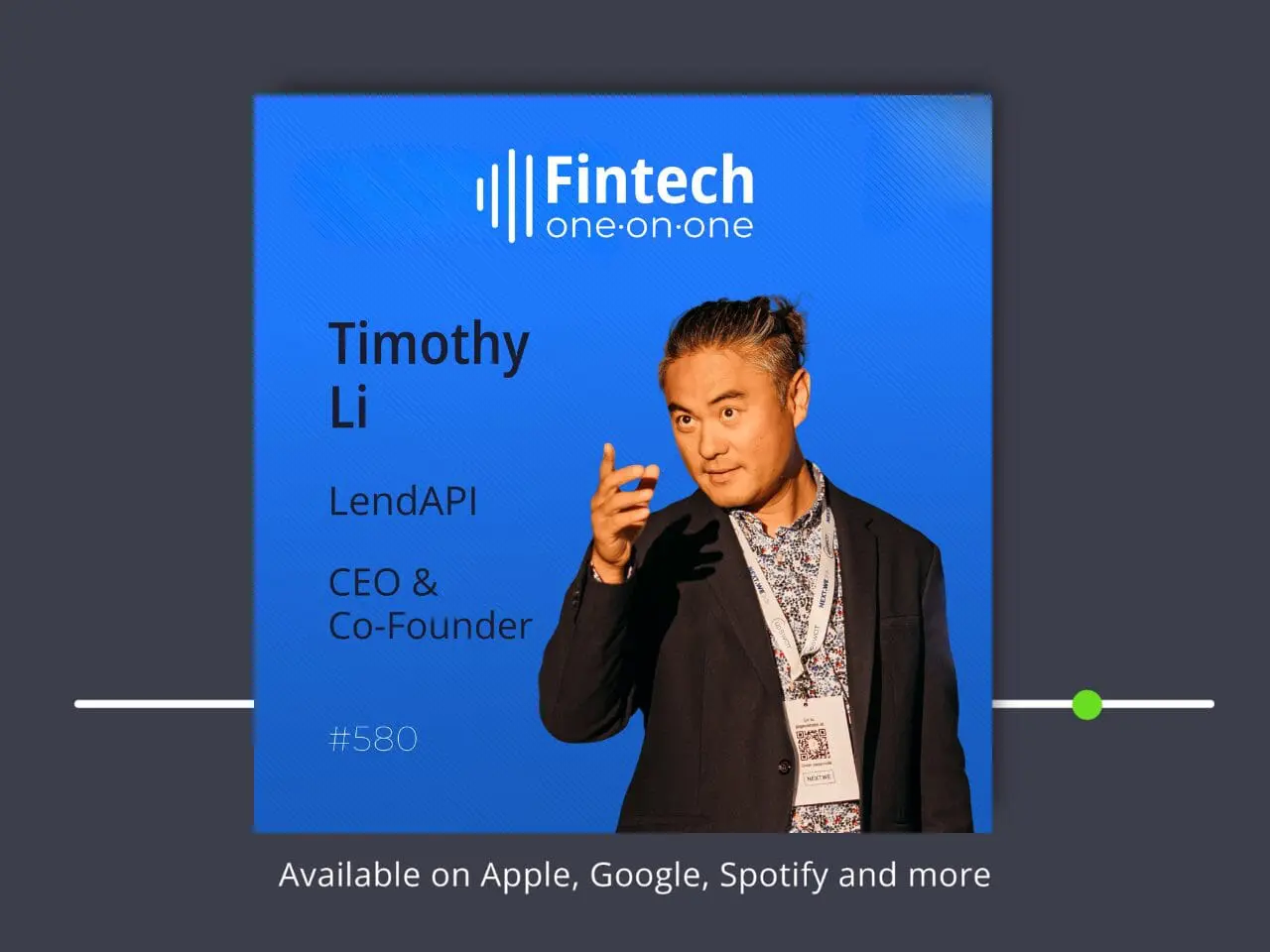
Timothy Li, CEO and Co-Founder of LendAPI, has spent nearly a decade trying to solve the same problem: launching a lending product takes too long and costs too much. With LendAPI, he’s built a no-code platform that lets banks, credit unions, fintechs, and retailers go from idea to live lending product in weeks, not months or years. Think of it as a GoDaddy-style experience for financial services. Timothy joined me again on the show (he was last on in 2017) to talk about what’s under the hood, what the Sunglass Hut deal reveals about embedded finance, and where he thinks AI is actually useful in lending today.
What We Covered
- Timothy’s path from the Fluid college credit app to building LendAPI
- How the drag-and-drop product builder works for non-technical users
- Python model deployment for credit risk officers inside the same platform
- Winning Best in Show at Finovate
- The Sunglass Hut deal and how it came together in three months
- Why retailers are moving away from pure-play BNPL providers
- Integration options: bank cores, side cores, and direct e-commerce embed
- The 300-plus partner marketplace and the SEO strategy behind it
- Doc AI and single-task AI agents for document processing and underwriting
- Timothy’s experience in the CURQL accelerator and how credit unions differ
- Teaching FinTech Fundamentals at USC
- The five consumer verticals with the most opportunity in fintech
Key Takeaways
The build vs. buy debate is essentially over. When Timothy talks to bank CTOs today, the conversation is “can you launch this next week?” not “should we build this ourselves?” Speed to market has become the dominant concern.
Pure-play BNPL approval rates are outside a retailer’s control and can swing 10 points overnight. Private label embedded finance, built on infrastructure like LendAPI, lets retailers and banks own the underwriting criteria and the customer experience, which matters especially for high-ticket items where the financing decision happens in-store.
Single-task AI agents are the near-term opportunity in lending, not fully automated credit decisions. Automating document verification, data extraction, and intake workflows saves minutes per application, and at scale, that compounds quickly.
The five consumer fintech verticals worth building in: mortgages, auto, credit cards and personal loans, payments, and bank accounts. If it’s in someone’s wallet, there’s still work to do.
About Timothy Li
Timothy Li is the CEO and co-founder of LendAPI, a no-code lending platform that launched in 2024 and won Best in Show at Finovate. He previously built Fluid, a credit-building app for college students, and has been building lending infrastructure across multiple ventures over the past decade. He also taught FinTech Fundamentals at the University of Southern California.
Transcription
Timothy (00:10.19)
Can we ultimately get to a point where we can launch products without even thinking about it, right? 10 years ago, 20 years ago, if you want to build a website, you have to hire a webmaster, play with HTML code and all that stuff, right? It’s very cumbersome. Today, you go to GoDaddy, get a domain, take a template, edit the content, press the button. You can launch your own thing. I want to bring the same experience here. ut we’re getting there, right? So no longer do you have to say, my God, I have to raise $5 million and hire a bunch of engineers and get to market maybe next year. You can use this, launch, try it, see if it’s successful, launch another product, and just go forth with it.
Peter (00:48.44)
This is the Fintech One-on-One podcast, the show for fintech enthusiasts looking to better understand the leaders shaping fintech and banking today. My name is Peter Renton and since 2013, I’ve been conducting in-depth interviews with fintech founders and banking executives. My guest on the show today is Timothy Li, the co-founder and CEO of LendAPI. Now LendAPI is a no-code lending platform that allows banks, credit unions, fintechs, and even retailers to launch their own lending and point of sale financing products quickly and without the heavy engineering investment. Think of it as a GoDaddy-style experience for financial products. Drag, drop, customize, and launch. In this conversation, we talk about how LendAPI works under the hood, from its visual drag-and-drop interface to its deeper capabilities for credit risk officers who want to deploy custom Python models. We get into their interesting Sunglass Hut deal and what that says about the embedded finance revolution. We also discuss Tim’s participation in the CURQL accelerator focused on credit unions, his marketplace of 300-plus fintech partners, and the AI-powered tools LendAPI is building to automate document processing and underwriting workflows. Now let’s get on with the show.
Peter (02:29.742)
Welcome back to the podcast, Tim.
Timothy (02:31.436)
Thank you for having me again.
Peter (02:33.198)
Yeah, it’s been a while. I look back at my notes. It’s been almost nine years since you were last on. It was 2017. Hard to believe that was nine years ago. We recorded a podcast — I’m sure you remember — in Shanghai. That’s right. And when we were there, I was part of our China trips. But tell us what you’ve done the last nine years or so.
Timothy (02:53.72)
Well, first of all, I have one more kid since then. You know, that app that I built nine years ago, ten years ago was called Fluid and it was helping college students build credit while they’re in college. And I feel like that problem still hasn’t been solved. But in that journey, I said, well, you know, it took me a while to build a platform to manage all the loans, do all the payments, report to the bureaus. And I said to myself, I’m in this situation, I sort of kind of know how to do these things, but what about the other people? So I went on a long journey building lending platforms, lending cores to help the likes of me, right? If I want to build it again, I want to go to market really quickly, save all that investment I raised for marketing and customer acquisition — less about spending all that money building a platform that should have been commoditized. So I built a couple of these. And fast forward, I’m doing it again. I tell people this time, I don’t even want to build this anymore. So I built an almost a Figma, Framer-styled platform. It’s a DIY kind of a thing where you can actually log in, get an account and build it yourself. We have all the widgets and wizards and things like that for you to quickly build something on your own without having to hire a team or invest heavily in the infrastructure. I attempted to commoditize the product-launching activity for anybody. It could be a bank, community bank, or just a fintech themselves. So that’s what I’ve been doing for the past nine years.
Peter (04:26.67)
But you launched LendAPI — it’s relatively recent.
Timothy (04:30.774)
Yeah, so we just finished our second year anniversary, March 1st of 2026. Officially, we’re in year three. I think with everybody else — serial entrepreneurs — you learn a bunch of stuff along the way. So this time I got a new partner, got a new team. We kind of know what we’re doing now. So we were able to get this thing up and going, getting customers, getting to revenue slightly quicker than the previous venture. So we’re blessed to have a lot of really good people working on the team. So yeah, it’s only been two years.
Peter (04:59.48)
Where are you at on the fundraising journey? I think you started bootstrapping it, but where are you now?
Timothy (05:06.102)
Yeah, I’ve always been a bootstrap founder and my co-founder Sam, he’s a bootstrap founder as well. Both of us made a couple of exits and we were still having a lot of fun doing this LendAPI thing and we got selected and wrapped into Techstars. So we both moved to New York City for about a month, joining the Techstars program with Andres Barreto as our MD. And as part of that journey, we really said to ourselves, to each other, like, my God, I mean, maybe we have something here. Maybe the venture capital route is the right route for this venture, for this company, that we can really raise money to scale, right, to really make a difference. And to do that, we can bootstrap this for 10 years, or we can get VCs to help us and get to a real outcome, maybe in five to seven years, to shortcut a little bit. So we changed our mind and said, you know what, let’s go raise money. And to answer your question, we raised a seed round. People don’t even mention their series name anymore. We raised a $3.2 million seed literally two years ago in 2024 from Cohen Circle in New York City, Alley Corp in New York City, and Great North Ventures out of Minneapolis. Plus some of the local guys — Interlock Capital down in San Diego, Plug and Play, Techstars — all sort of chipped in to round out that tail. So we’re on the journey to raise our second round. We’re in the midst of doing that right now. It’s really helped us to grow on a solid glide path.
Peter (06:34.4)
I watched your presentation at Finovate and congratulations on winning Best in Show there. That was awesome. And the pitch I think you were doing there was a mortgage loan and you just sort of showed how you could launch a new mortgage product. So with that in mind, why don’t you tell us a little bit about the types of products that you are launching and what it looks like and how it works under the hood.
Timothy (07:04.066)
Yeah, I’ll give some flavor to this. You know, the way we built this thing — and this is a terrible thing to say — is everything to everybody. You can literally build whatever you want to build down to the fields, down to the page, connecting all the third-party data providers to make that decision, right? Every page, every button. But what we find ourselves in the midst of is this whole embedded finance revolution. You know, there’s Klarna, Affirm, Sezzle, Snap Finance of the world doing a lot of these one-click checkout, pay in four, BNPL kind of things. And the way we structured our platform sort of fits right into that genre. So what we have done on a good day is that we’ve commoditized this technology. So any bank, financial services company, credit union, or even big retailers that want to build their own BNPL or point-of-sale financing experience could use our platform and launch within a month or two. They can customize the look and feel. They can introduce rewards programs, insurance products right in that flow. The look and feel is exactly on brand. And also they can control — which is one of the most important things — the underwriting criteria. A lot of the pure-play BNPL players will say, hey, it’s our way or the highway. We’re going to give you a 50% approval rate. The other 50% you’re going to have to deal with on your own. So these retailers, or big banks, are saying, well, we want a higher approval rate because we want to work with our merchants a little better, more consistently, and serve everybody. So the only way to get there is to probably build their own experience and have that waterfall within their control, so they’re not beholden to somebody else’s credit underwriting strategy. Today it’s 46% approval, tomorrow it might be 40%, next day it could be 50%. So they can’t control that in-store, in-branch experience using a pure-play BNPL player because those players make decisions to cater to their own portfolio health, right, not necessarily a better customer experience in the store. So we find ourselves in this whole embedded finance space building a lot of these private label solutions for banks, credit unions, and retailers so they can really own that process. And the customers feel better as well. I feel like it’s on brand. So when they’re buying some services or products, Peter, they’re not being shunted off to another brand. “Oh, I have to go here to apply for financing and come back” — it feels like a little bit of an out-of-body experience. Whereas we have done everything in one sitting.
Peter (09:33.484)
So if a bank comes to you and, say, they might have commercial real estate, might have a small business operation, and they say, look, we really want to have a personal loan product. And they’ve never done this before. How do they integrate it into their existing loan management system?
Timothy (09:52.91)
So we have the entire loan core. We have a loan originations and loan management system from the apply button all the way to collecting the repayments on the loan. So some banks will say, Tim, we’ve got to integrate into Jack Henry’s Symitar. We’ve got to integrate into Fiserv’s DNA. That’s our bank core. Whatever phase we’re in, it’s got to dump all the data in there. So we’ll do those integrations. Some will come to us and say, well, there are so many concurrent projects going on, it’s so complicated. We’ll leave our core as is, but we really want to get into patient financing or point-of-sale financing, financing auto loans or both, whatever it might be. We’re just going to use you guys as a side core. Don’t touch the main core because we’re still trying to figure out what’s going on there, but we can marry the data together at some enterprise data warehouse level. It’s still connected at some reporting level. Then we have people who say, we’re really just a credit union that wants to do a lot of loans. And one of the spaces we find ourselves in is embedded finance: inject us as a checkout option or a financing option inside these e-commerce sites. So we certainly have a lot of credit unions saying, you know what, this is going to be financed by such-and-such credit union, and there’s an Affirm-like experience funded by these credit unions to do more loans, to get more members. So there’s all sorts of ways of cutting this — integrating into cores, setting up a side core, or integrating directly into the e-commerce site and just doing it independently to get into the market.
Peter (11:27.37)
And when I was watching your demo, I noticed it’s like a visual interface, just drag-and-drop sort of thing. It doesn’t look like there’s any coding involved. So a non-technical user can kind of set up the interface, right? How do you kind of balance this sort of drag-and-drop with the demands of the other operators at a bank?
Timothy (11:51.042)
Yeah, this thing goes really deep and we sort of think of our platform as a collaborative platform. The product people, the risk folks, the compliance folks, and maybe even marketing can all come into this platform and do their work. There are product studios, rule studios, model runtime studios, places where they can actually edit or create promissory notes, consents — all that stuff is in different doors down this hallway. So it entertains all skill sets. Everything at its face value is drag-and-drop. Do it yourself. If you can imagine going to GoDaddy, getting a domain, taking a template, editing some content, pressing the button to launch — that’s the experience we created for everybody. Now for the chiefs, right, for the senior credit decision science people — the quants — they may have a piece of Python code that they’ve been dying to implement because it’s the latest machine learning model they’ve created. We have the spaces where they can literally copy their code right into an editor, compile it, and that model is automatically launched. So we have things catered to folks that just want to design the nicest onboarding flow — four or five pages or 20 pages — and then we have places on the backend to even host a compiled binary file that contains their IP and runs credit risk models. So we go really deep on both ends. I’ll give you an example. We had a Chief Credit Risk Officer in our office doing some training. They’re literally in the office and they say, hey, look, we have this machine learning Python code that we’ve been waiting two years to implement and there’s nothing in our space that can actually do this. We literally told him, hey, email it to us. In front of his eyes, we got it launched. That’s the depth of what we’ve done. And it takes somebody — like maybe you and I — who has worked in all aspects of a lending banking environment to think through this whole spectrum of needs. There are a lot of companies out there doing only text messaging for banks, only KYC or KYB, or only payments. LendAPI is a place where we’ve done everything, whatever C-suite title you have coming in, and there’s something for you to do. It’s a complete solution, as opposed to — in my opinion — not solving the real problem, which is an orchestration platform that works for everybody.
Peter (14:16.066)
There’s one thing I want to dive into a little bit. We chatted recently and you told me about it. This is your deal with Sunglass Hut, which was not on my radar as someone who wanted a lending program. And you know, as you say, everyone’s a fintech these days. So maybe explain what you’re doing with them and how that deal came about.
Timothy (14:36.972)
Yeah, so remember Angela from a16z, the famous fintech VC?
Peter (14:42.806)
Angela Strange. Yeah.
Timothy (14:45.358)
She says every company will become a fintech company. And true to her word, we got a call out of the blue from their (Sunglass Hut) financing arm. And we said, what are you trying to do here? Oh, you know, we have a bunch of subscribers in the UK doing this stuff, millions, and we want to bring this whole thing into the US. That’s our expansion project. And we couldn’t believe it at first, because we’re just a year and a half old. And I think they found us on the internet — you and I both created it. They just found us. We don’t have a sales team. So they just reached out to us. And they said, hey, we don’t want to import our technology from the European theater to here. We want new tech, faster launch, all the things that we’ve talked about, and go into all the stores. So we sat down with them. And long story short, we got them in production for financing in three months, which is a testament to our platform. We had built everything already. If there’s any customization, we can quickly modify it to the Sunglass Huts of the world and get them in market. So there’s an iPad experience where the store staff can follow the customer around — “Oh, do you want this? Do you want that? Is this what you need?” — and send them a text message with a QR code. They can continue that journey on their mobile phone, do their consents, sign a promissory note, take a picture of their first payment method, and we take a down payment. And they can walk out of the store with those sunglasses and we will remit the remaining payments over the next 12 or 24 months, or whatever.
Peter (16:10.282)
It’s obviously a BNPL type product, but it sounds like you’re generating an installment loan.
Timothy (16:15.202)
That’s right. It’s a 0%, same-as-cash — almost like BNPL, but over 12 months. Some of their products, I feel like the parent company has bet their whole future on AI wearables. So the stuff that’s flying out the shop right now are these Meta Ray-Bans. They also own Ray-Ban, the brand. So Meta and them sort of collaborated to build these AI glasses. And that’s what’s flying out the shop. These are high-ticket items. Paying in four doesn’t really make it easy to afford it. So paying over 12 or 24 months makes sense. It almost feels like a Netflix subscription kind of model — $20, $30 a month, you get what you need. And plus they get to add their insurance product and their loyalty rewards program as part of that flow. They’ve gone with the household brands — Affirm and Klarna in the world — and they’re fine brands. But the point of conflict and interest, again, is the approval rate being volatile. And if they go to these guys and say, can you add these things and create a different customer experience? It’s not going to happen. It’s one-click checkout. So for those reasons, these higher-end retailers are saying, hey, why don’t we just do this ourselves? Own our own experience, have our own customer journey, really integrate into our POS system, and cross-sell.
Peter (17:29.87)
What does your customer base look like today? Obviously you’ve got banks, credit unions. Sounds like you’ve got retailers as well. Who are you working with? Fintechs as well, I presume?
Timothy (17:40.438)
Yeah, fintechs, banks, credit unions, CUSOs — credit union service organizations — retailers, and run of the mill financial services companies. And it doesn’t matter who we’re dealing with — the product is the same. It’s point-of-sale financing. It’s B2B2B or B2B2C. Whether it’s a bank financing it, private credit, or the retailers financing it themselves, it’s the same or a similar product. But we work with just about everybody that wants to launch something on their own that needs technology basically.
Peter (18:11.502)
I also want to talk about your marketplace, which is an interesting thing that you really launched a while back. Why did you decide to do this marketplace? What is it providing to the industry?
Timothy (18:23.18)
You know, I started this thing two years ago, right? And this is essentially a B2B software company. So in my mind, I’m like, how do people know about LendAPI? How do people find us? I didn’t know how to do marketing or SEO or playing around with Google. So I said, you know what, other people have figured it out. There are a lot of companies that started with nothing. How do they do it? How do they generate traffic to the website? So every morning when I go to the office, I’d pick out a random YouTube video to learn how to do SEO or SEM or GEO they call them now. And all of them are very salesy — “Oh, you’ve got to hire us to do the real SEO work.” But one day there’s a guy who sounds like a real teacher in this space and he talks about a bunch of stuff. And then a couple of minutes into that episode he says, “If you’re starting from zero and you want to generate traffic, you need to be the source.” And I just fixated on that statement. I’m like, what does that even mean? Got to the office, started thinking about it. And I’m like — for LendAPI to do what we need to do, we have to partner with just about everybody under the sun. From KYC, KYB, to all the credit bureaus, to all the Plaid’s of the world, all of these third parties that would come in and help my clients make those decisions — payment gateways, Moov, for example. And I said, well, I am the source from that kind of a perspective. Why don’t I have a marketplace on my website where people can find all of these players? Whether you’re doing identity verification, fraud detection, credit bureau reporting, cash flow analytics — come to LendAPI and find these people, almost like a registry, like a yellow pages. But tangentially, if people are searching for these partners, there might be a chance for my name to show up. So that was my hack, my desperate hack to say, maybe I can write for the long-tail keywords. That if somebody types in “Plaid” on Google search, there might be a chance it says, hey, Plaid is integrated with LendAPI. And people are like, what? What’s LendAPI?
Timothy (20:46.518)
And somehow or another, Peter, that worked. So software-wise, it was a way for us to get noticed. And secondarily, I need to have a listing of the folks that work with us anyway. So if somebody wants to launch a new product and they think I like Socure, like Plaid or Equifax — Tim has already got these things integrated. Great, makes my decision a bit easier. Of course, we work with so many people that sometimes I forget who we work with. So when I talk to a client, I’m like, okay, go onto our website, go to Marketplace. There are people literally on those sub pages. Call them directly, get a deal going. So instead of hunting for that sales email or phone number, they can go to my website, go to Marketplace, find the category they’re interested in, and actually talk to a real person in the partnership or sales department and shortcut the amount of paperwork that needs to be done. And then interestingly enough, one of the VCs on X — on Twitter — I just saw it. They said, “I found this new deal flow source” and it was the LendAPI marketplace. Apparently, we list a lot of new fintech startups in the space as our partners on that site. And he’s been using it as a discovery channel for new investment opportunities. He’s been going through our website to find new people to talk to. So there’s a limited but real benefit. But yeah, keep on growing — we’ve got 300 partners in there now.
Peter (22:12.782)
I want to talk about AI for a minute — not so much the product development or coding side of AI, but I’ve read that you’ve got products called UnderWrite AI, Doc AI, MyOCR.ai. Tell us a little bit about your approach here.
Timothy (22:29.058)
Yeah. Well, you know, the meme nowadays is that SaaS is decade and that AIis eating the world. And I feel like people who work in fintech, financial services, or the medical field still have a bit of a moat. Right now, I still can’t really make the ultimate decision of issuing credit. That’s the FCRA, ECOA, UDAP — all standing in the way of that. And the regulators in our space haven’t accepted that just yet. But when I talk to credit unions and banks — for example, we visited a bank in Florida whose aspiration is to double their members from 1.5 million to 3 million, and double their portfolio from $15 billion to $30 billion — I ask them point blank, you know, it’s kind of a juggling act. Are you going to hire 3,000 more employees or build another hundred branches? The answer is clearly no, but they want to do all that stuff. The only way to get there is to do a massive amount of automation, right? To free up their staff to build new products and build new assets. And when we look at the AI world, we certainly build some stuff ourselves. For a bank to accept that an AI agent makes the ultimate credit decision — we might be two or three years from that. But we can bring in agents that do singular tasks that can save a minute or two per application for each real person sitting in a chair. So we build these singular tasks. Our Doc AI product, for example, Peter, literally reads in anything that could be scanned in. It could be a driver’s license, passport, financial statements, certification of good standing, W-2, 1099, whatever that might be. And it actually understands the context of what’s being read in. Beginning balance, ending balance, debits, credits — all of it is in that piece of document. And it will do something with it. It will do math. All the math checks out — the beginning balance adds up to the ending balance with all the credits and debits, right? All the watermarks are there. The information extracted from the bank statement matches the information provided on the application. So it does all these rudimentary things that a processor or junior underwriter would otherwise do. And it just saves a lot of time. It’s consistent, it works 24-7, it really frees up a lot of people to do higher-level tasks, such as making that critical credit decision — not going through the bank statement line by line. Even if you’re the most…
Timothy (24:53.108)
…experienced person, it will take a couple of seconds to go through. A junior person might take four or five minutes. And those things, when you go from 1.5 million to 3 million of anything, those two or three minutes add up. So these are the tools we’re building. Not necessarily making the ultimate credit decision — I think we’re pretty far away from that because it’s regulated. But these single tasks — understanding the document, understanding what’s being said in an SMS message, understanding what the customers are emailing you with attachments and being able to respond and act on it — these singular task AI agents are very popular in our space. And it’s not me creating hammers to find nails. Our customers demand this.
Peter (25:36.406)
You mentioned Techstars, but I also saw you’ve been selected for the CURQL accelerator, which is all about serving credit unions. How are you approaching credit unions? And is it a different approach than what you would do with banks and fintechs?
Timothy (25:55.0)
Fintechs, banks, and credit unions or community banks are all trying to cater to their clients, but credit unions have a different agenda. Their shareholder is their members. All the decisions they make are member first, member only. They’re a not-for-profit organization, so they’re not trying to please some other shareholders by extracting the last dollar from their clients. So for that reason, the type of product we build for credit unions is very member-friendly. Lower rates. Trying to find ways to approve people, as opposed to trying to find ways to decline people. The whole process of building this product — not just from a UI, UX perspective, but underwriting, pricing, the way they collect, the way they communicate with the customers — all of that has a different flavor to it. It’s very human-centric. And the people who work at credit unions are very cool too. They’re a lot less anxious. They’re all very friendly to talk to. But fundamentally, they all have needs. Can we do digital issuance on credit cards in real time for our members? Can we extend our mortgage application all the way to the hands of realtors that help our members get moving to their next home? Can we do a home improvement loan at the heels of a mortgage application that was just being approved? So they’re thinking about these products to help their members get through day-to-day life. No different than banks and financial services companies, but they have a slightly different agenda. And the CURQL Fund is funded by 160-plus credit unions. So it was a great experience. We get to visit all of these credit unions. Last week, we were in Washington, DC, visiting Bank Fund Federal Credit Union. They’re the credit union for the IMF and the World Bank. So they have around 100,000 members and these members are well taken care of by their constituents and governments and all that stuff. So they have a lot of high-end mortgages they need to take care of, and people with certain needs. So that credit union has a completely different perspective than another one that’s serving near-prime, slightly sub-prime communities, really in the community, helping them to not take a payday loan but take a loan from us and help them ride through whatever economic situation they’re in. So all these credit unions have an agenda to serve their members, but the approach is different. And for that reason, our team kind of likes that approach. Being part of the CURQL program is a breath of fresh air. But at the end of the day, people still need technology to deliver products to the client.
Peter (28:29.396)
How should we think about LendAPI and its place in the lending ecosystem as far as infrastructure goes? I mean, there are obviously others doing embedded lending. How do we think about LendAPI and its place?
Timothy (28:47.414)
We think of ourselves as just a gigantic orchestration platform that can launch products quickly. Get to market fast is the number one agenda on people’s minds. 10 years ago, Peter, when I first started, there was still a dichotomy of build versus buy. Right now, when I talk to the CTOs of these banks, they’re like, “Thank God you’re here. Can you launch this thing next week? I can watch you do it.” So nobody even thinks about building this stuff themselves anymore. It’s all about getting to market quickly. To do that, I’ve got to have lots of these partners. We can’t do everything on our own. And yes, we have certain features that overlap with some of our partners. LoanPro, for example, might see us as a competitor. We interviewed everybody. We have a new project with a subsidiary of Berkshire Hathaway. They decided to use Oscilar, Loan Pro, and other vendors we have relationships with. And if you look at these vendors, does LendAPI have some of these features or functionalities? We do. But we let our clients speak on it. Dealer’s choice. If they want to use Oscilar, Taktile, whatever it might be, bring it in. It’s not a LendAPI show. But we will connect everybody and let the client choose which vendor they want to work with. My job is to make sure they’re all there. So when they do choose to work with them, it’s just enabling a button, putting in credentials, and lighting it up — whatever attribute scores flow through, whatever Alloy for example, they come right to the system. We don’t really have an agenda either way. But the main point is getting people to market fast.
Peter (30:29.006)
Okay, I want to switch gears and talk quickly about the course you teach at USC called FinTech Fundamentals. So I’m curious to know when you’re chatting with your students, what do you tell them about where the biggest opportunities are in fintech right now?
Timothy (30:46.198)
I taught that course for about two semesters at USC, University of Southern California. And some of my students have gone on and raised money and built fantastic cryptocurrency, blockchain, and stablecoin companies. They raised a bunch of money — probably raised more than I’ve raised — which I’m really proud of. So when people ask me, “Tim, what do we build? What should I build?” my clear answer is: look at the average US consumer. What are their big concerns? Mortgages, cars, some kind of personal credit to live through their day. Mortgage, car, and probably credit card — if you want to work in consumer banking fintech, it’s probably one of those three. These are the most important decisions people make. Buying a vehicle that’s going to last three, four, five years. Buying a home that’s going to last 20, 30 years. Having a credit card relationship that lasts an average of seven or eight years. And then maybe bank accounts and payments are the fourth and fifth. So if you want to work in fintech — if you want to build something or work somewhere — those are the five things people revolve around and think about all the time. Mortgages, auto, personal loans or credit cards, payments, and bank accounts. Build a mortgage app. That’s probably your best bet. Build for the biggest money-revolving sort of product, all the way to payments, where there’s still a lot that needs to be done. And nowadays, payments are all about stablecoins and cross-border stuff, which we’ve kind of talked about in other episodes we’ve both been on. So those are the five things I tell people — budding entrepreneurs, students, everybody. Five things you want to attack. Just open up your own wallet and see what’s in there. Those are the fintech verticals you want to get into. Even if you get into a crowded space, that means there’s demand for it. And credit cards is about $1.2 trillion. Any basis points of that — that’s a bonafide company.
Peter (32:51.586)
So last question then — what’s your vision for LendAPI? And if we talk again, say hopefully before nine years — let’s say we talk again in five years on the podcast — what will you have hoped to have achieved by then?
Timothy (33:03.764)
My personal mission and vision hasn’t changed since nine years ago. Can we ultimately get to a point where we can launch products without even thinking about it? 10 years ago, 20 years ago, if you want to build a website, you have to hire a webmaster, play with HTML code and all that stuff. It’s very cumbersome. Today, you go to GoDaddy, get a domain, take a template, edit the content, press the button. You can launch your own thing. I want to bring the same experience here. We’re getting there. So no longer do you have to say, “My God, I have to raise $5 million and hire a bunch of engineers and get to market maybe next year.” You can use this, launch, try it, see if it’s successful, launch another product, and just go forth with it. I want to lower that barrier to entry to nothing. Total cost of ownership to nothing. So I can enable myself from 10 years ago, if you will — and all of the people, including Sunglass Hut, who didn’t think they were a fintech but they are now — to launch their products on their own with minimum amount of help, and just launch products.
Peter (34:05.068)
Yeah, and as you say, there are going to be people starting businesses in five or 10 years time that will benefit from all the technology that has come before. So anyway, always great to chat with you, Tim. Thanks so much for coming on the show. Best of luck.
Timothy (34:18.05)
Thank you, Peter. See you soon.
Peter (34:25.934)
For anyone creating and launching lending products today, it is a good time to be alive. Speed to market is often a critical piece of the puzzle and what LendAPI has done is create a launch platform for the next iteration of financial services. Just as GoDaddy made it trivial to launch a website, LendAPI is making launching a lending product equally accessible for banks, credit unions, fintechs, and even non-financial companies like Sunglass Hut. The build versus buy debate is essentially over in his view. Speed to market is now the main conversation CTOs want to have. Anyway, that’s it for today’s show. If you enjoy these episodes, please go ahead and subscribe, tell a friend, or leave a review. And thanks so much for listening.


