
Transforming the Middle Layer of Banking with the CEO of Aliya
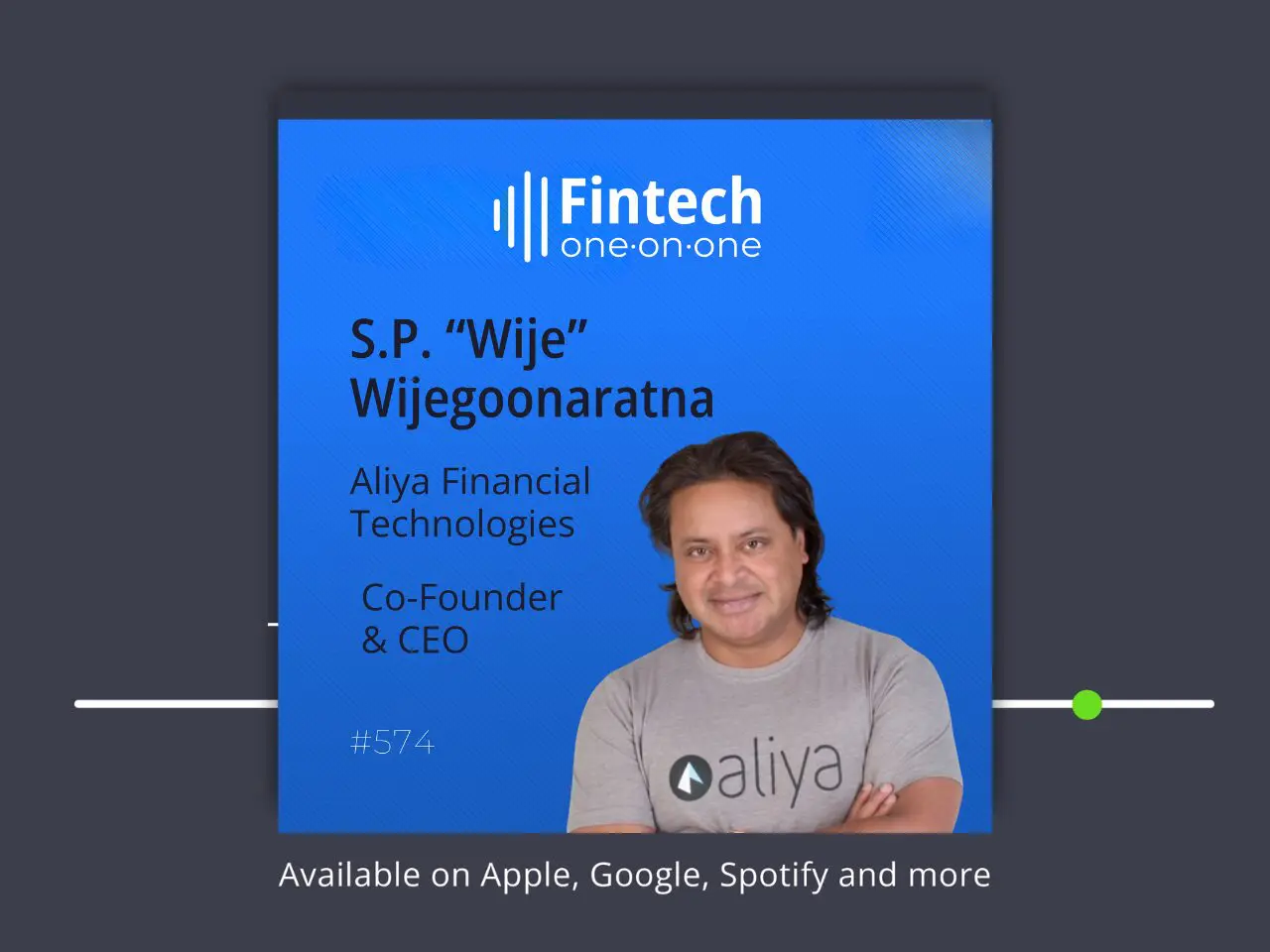
We often talk about the “front end” customer experience or the “back end” systems of record. But according to S.P. “Wije” Wijegoonaratna, the founder of Aliya, the real revolution is happening right in the middle. From his early days in the UK to his time in the high-stakes world of New York hedge funds and his role as an early investor at SoFi, Wije has consistently found himself at the intersection of financial data and decision-making.
At its core, Aliya is an operational intelligence layer that sits between a bank’s customer-facing front end and its core system of record, what Wije calls “the middle.” It combines transaction categorization trained on 1.5 trillion transactions from nearly 1,500 banks, dynamic risk segmentation, and real-time post-origination monitoring into a single microservices platform.
In our conversation, we discuss why Aliya went after the largest banks first, how their approach to post-origination risk management drives charge-off rates as low as 2.5%, why Wije believes Nubank poses an existential threat to regional and community banks, and why he thinks the biggest opportunity in banking today lies in transforming that middle layer.
In this podcast, you will learn:
- How meeting Mike Cagney and the founders of Palantir was the catalyst for the birth of Aliya.
- Why they decided to start with helping banks with lending.
- The two core offerings Aliya has today.
- Why the cumulative losses on their portfolio is far better than most lenders.
- How they decide when to take action on a consumer that may be having problems.
- Why they chose to focus on selling to the large banks first.
- What they are providing to the large banks exactly.
- Why Aliya doesn’t fit into any fintech category.
- Where the biggest opportunity for Aliya is today.
- Why Wije believes Nubank is going to be successful in the US.
- What is next for Aliya.
Read a transcription of our conversation below.
FINTECH ONE-ON-ONE PODCAST NO. 574: S.P. “Wije” Wijegoonaratna
S. P. “Wije” Wijegoonaratna:
We talk about the impact of AI on industries. Here it is. Banking is not an exception. You know, we can take a loan program that’s run by 50 people and run it with five, and it’s all intelligence driven because everything is data. Historically, I always think of the NASA Commander & Control Centers, right, from the old days where they each person had a screen in front of them and each person had a single responsibility, which is to monitor something and tell the boss what’s going on. And if something’s happening, right?
Well, we have AI to do that and they will tell you what to do and then the human just will decide whether to do it or not and eventually the human won’t necessarily be part of it.
Peter Renton:
This is the Fintech One-on-One podcast, the show for Fintech enthusiasts looking to better understand the leaders shaping Fintech and banking today. My name is Peter Renton and since 2013, I’ve been conducting in-depth interviews with Fintech founders and banking executives. Today on the show, I’m delighted to welcome Wije. I’m not going to try and say his full name. He is the founder of Alia Financial Technologies.
Wije has an interesting backstory, born in England to Sri Lankan parents, educated there, recruited to New York by US investment bank, then he just never went back. From there, he built a career working alongside some of the legends of the hedge fund world before becoming an early investor and board member at SoFi. But what Wije has built at Aliya is something genuinely different. It’s a company that is hard to categorize. And I say that as a compliment. At its core, Aliya has developed an operational intelligence layer for banks, with its roots in lending, but it is much more than that.
In our conversation, we dive into this Alia OS and why they decided to go after the largest banks first, how they managed post-origination risk in real time, what new banks US launch means for regional and community banks. Yes, we cover that too. And why Wije believes the biggest opportunity in banking today is what’s happening in the middle between the customer facing front end and the core system of record. Now let’s get on with the show.
Welcome to the podcast, Wije.
Wije: Thank you. I’m really delighted to be here.
PR: Delighted to have you. So let’s get started by giving the listeners a little bit of background because I know you’re not from this country just like me. You grew up with the part of the British Commonwealth. So tell us a little bit of your background, how you came to be in this country and what you did before you started Aliya.
Wije: Originally, my parents are from Sri Lanka, but I was born and educated in England. studied computer science and I was recruited by a US investment bank out of London and was sent here to New York on a six month training program. After which I said I wouldn’t go back. That’s how I ended up here. I fell in love with New York city and chose to become a New Yorker was the simple answer. And then they gave me a job here and I didn’t last very long because I got bored.
And I was very lucky to be offered a position in a hedge fund, which at the time wasn’t something that was well known. And I spent the first part of my career in the hedge fund industry. I worked for Julian Robertson and George Soros, who were prominent hedge fund managers at the time and was a partner at Moore Capital and partner at Fortress before I ended up getting involved in data-driven investments.
My story was very simple. I knew nothing about technology. And I was just curious because the best and the brightest were going to Silicon Valley. So I went there, literally parked myself at the Mandarin in San Francisco and walked the streets and hoped I would meet people. And that’s how it happened.
PR: That is great. Well, then tell us a little bit about then the story of Aliya and how you kind of came up with the idea. I you don’t have a tech background, as you said. I mean, you’ve got a hedge…you worked at hedge funds. That’s not really a great prep for running a lending infrastructure type company. So tell us a little bit about where you get the idea and how it all started.
Wije: So it’s carrying on with my entry into Silicon Valley and data-driven. And one of the leads led me to SoFi. I met Mike Cagney. I was fascinated by what he was doing, very interested in it. And another lead led me to the folks at Palantir. I met Joe. I met Stefan. And the fascination for data-driven intelligence has always been there, because that’s how I invested. I was a macro investor.
I was very interested in high frequency data and what that could do. And as you well know, I mean, even to this day, banking is managed on very low frequency data and it’s not very predictive. And, you know, like every decade we have a recession and the banks lose money. So something that happens consistently and with real pattern recognition didn’t make sense to me.
So cut a long story short. It was pretty simple. The idea was that there was a better way to do a lot of this stuff. And I really didn’t have any preconceived notion of what it was going to end up. But I did know one thing, which was the bank transaction data was incredibly valuable because every transaction in the world begins and ends with a bank. It has huge behavioral value. And that when I first came to New York, I wasn’t very well paid and New York was expensive. So you had to be very careful about your income and expenses. So the idea was, how do I determine a responsible spender, i.e. low volatility? That’s how it kind of started, and then it evolved, but turned out to be a really difficult thing to do.
PR: Right, indeed. So then why focus on lending specifically? mean, it’s a competitive market. mean, there’s has been existing players helping banks and fintechs for that matter, know, lend. So what did you like specifically about lending?
Wije: It was never about lending. Lending is the way banks make money. So I never wanted to be an expense line item for a bank. I needed to create incremental value. thought when you’re an investor, you think in terms of ROA efficiency ratios, right? When you invest in a bank, the valuation of a bank is really highly correlated to those two variables. And when you think about it, banks were inefficient, the ROAs were terrible, they still are, and yet we continue to operate the same way.
To tell you the truth, you know, SoFi was a really interesting experience. You know, I thought that that was going to be the transformation of banking, but the bank, SoFis of the world didn’t have the data, they didn’t have the capital, they didn’t have the customers. The banks had this advantage. It’s just that they hadn’t figured out how to use it and I wanted to change that. We went down the path of lending because we could make some money whilst we were building the other stuff. The other stuff is really what’s valuable, which is the transaction.
I don’t know how familiar you are with transaction categorization and the problems of it. It’s a lot of gibberish and we have to be accurate. Gibberish and accuracy, those things don’t go well together and we failed for a long time, but you learn from the failures and suddenly you have this aha moment and it breaks through. But then you have to prove it out. But once you prove it out, it’s tremendous value. If you just think about this, Peter, and you’re an investor and you’re a very knowledgeable investor, if you could take a bank that has a 1 % ROA and a one-times price to book, but has an efficiency ratio of 65…if you could take that bank’s efficiency ratio to 35, what do you think is going to happen to that ROA and the price to book? The example being Nubank. So Nubank’s efficiency ratio is 15%. Their price to book is seven. I’ll take half of that.
PR: Right. Well, they are the hottest fintech company on the planet. So it’s not exactly a typical fintech company.
Wije: My point is that if you don’t find a way to make that change, it’s possible that they’re going to eat your lunch.
PR: Right. Well, so I have done in Brazil who just like the Brazilian and Mexico. Yeah. They like the Brazilian banks dismiss them and now they are bigger than every other bank.
Wije: And they were fighting an oligopoly. So it’s even more impressive. But my point is what we’ve built is the solution that will help banks compete. Lending is just a component of it.
PR: Well, let’s, talk about that. Maybe you could explain exactly what you have built so we can understand it.
Wije: What we’ve built is so the AI components are in the two models. One is risk configuration, risk segmentation. The other one is the transaction categorization. That is an LSTM neural network trained massive model. It’s been trained on one and a half trillion transactions from close to 1500 banks. And as you know, you can’t train on one bank. So that’s taken a long time to develop and the accuracy levels are the critical KPI, right? We have to be 99 % accurate in determining the free cash flow of an individual. And we can do that for any bank account and we can aggrgate that.
So that is integrated with additional IP that is focused on dynamically creating offers. And then all of that is wrapped in a workflow that basically can close an unsecured loan in under five minutes. Fully baked and then here’s where we’re different. The portfolio construction drives the marketing. And this is an important difference that comes from our hedge fund background. My partner and I both come from the hedge fund side. We focus a lot on risk rather than filling the funnel and looking at what we end up with.
We want to be very targeted about how we use our marketing dollars to fill the portfolio that has very specific risk adjusted return criteria. What that allows us to do is to be more proactive in post-origination risk management. Like don’t make a loan and just forget about it until it goes bad. We need to be well ahead of it. The benefit of that is you significantly reduce charge off volatility. And of course you reduce the charge off curves. You know, the typical [cumulative] losses, 850 to 600 portfolio…let’s take SoFi [cumulative] loss is 6-7%, ours are 2.5%. Very different.
PR: Why do you attribute that to?
Wije: It’s really a combination of one having a powerful risk segmentation model. And listen, we’re not the smartest guys in the room. There’ll be people who have better models. That doesn’t matter. It’s really the combination of that. It’s a six layer process for us. The credit risk is one component. The next component is cashflow analysis so that we understand real affordability. And that allows us to size the loan properly. Very important.
The third piece is creating a risk adjusted offer. Basically, the probability of default determines the tenor. It determines the price. It’s not some static matrix. It’s dynamic, right? You got to have a great workflow experience because you want to drive positive selection bias. You don’t want 26 screens and have to go into the branch to close a loan. That’s adverse selection.
We want to do it even better than anybody out there. Like ours is five screens. The good news is that everything is happening in the background from fraud, BSA, transactions, everything. Then you’ve got to be able to monitor the post-origination. Most people just make the loan and forget about it. That’s not how you manage risk. And that has a significant impact because you know, as well as I do, bad things happen to good people.
That doesn’t mean you abandon them. You can offer them some degree of forbearance and give them time to get back on their feet. And they’re going to love you.
PR: So you are taking that transaction data, the cashflow data, is it being reviewed monthly? I mean, in real time, how do you decide when you want to take action on a consumer that may be having problems?
Wije: The risk is always about the second derivative. It’s understanding the inflection points. It’s really looking at various attributes and the second derivative is creating the heat map. So think of as we’re really going to focus on the top two deciles. So you rank order everyone, top two deciles is really what you focus on because that’s where the highest problems are.
And it’s typically being able to identify what the problem is. And a lot of the time it’s in the last 90 days, you basically see they lost their job, cash flows changed, and it’s a matter of going to them proactively and saying, not saying, hey, we saw that you lost your job. It’s about, if there’s anything we can do, let us know. And this was a tactic that, you know, SoFi deployed. I don’t know if they still do, but when I was…I was an early investor in SoFi and a board member and we basically encouraged people, they lost their job to contact us and enter the career services program and they would get 90 days forbearance. And it worked very well. Look, I think people are ashamed, so you’ve got to make it do it in a certain way that it’s anonymous and you can just go in and do it.
The other component that isn’t really talked about, Peter, is capital markets. We don’t leverage the capital markets the way we’re supposed to. The capital markets are the deepest source of liquidity, therefore the best pricing. And we’ve created a fully digital workflow. we can, you know, it’s the old Mike Cagney-Figure thesis, which is create an immutable contract and use the blockchain to distribute. That’s built into our workflow too. So it’s a way of managing risk, optimizing earnings, so which we call the future state, but ultimately, it’s just operating intelligence that sits between the front-end channels of customer facing and the core.
PR: Are you using the provenance blockchain the way that using figures blockchain or are you doing in a different way?
Wije: We’re not building anything. We will be using Figures Blockchain, but we haven’t got executed on that yet, but we’re going to use them. Nobody else.
PR: Understood, understood. So I want to ask about who you’re selling into because I was reading that you did something that was a little counterintuitive for a fintech startup and you decided to focus on the largest banks first, which is very difficult. And rather than going with a small community bank or a small fintech to prove everything works, you went straight with the largest banks. Why and how did you do that?
Wije: So the why is we’re nuts…The thinking has always been in our company, there two things. One, nothing is impossible. We just haven’t figured it out. The other one is you can’t win doing what everybody else is doing. While it’s a difficult path, we figured that if we could do it inside a big OCC regulated bank, we could do it anywhere.
They also had very large pools of customers. They had a forward thinking CEO. And it was just an interesting opportunity that we kind of didn’t expect, but we decided to just 100 % focus on it. We didn’t talk to anyone else. We just went all in. It wasn’t a straight line. Obviously, we’re trying to change a lot of things and the internal politics is tough to navigate.
But it’s always going to be the case when you’re trying to do new things, Peter. I mean, if you have any illusions about entrepreneurs and it being easy, think that’s, you know, people shouldn’t think that way. It’s very difficult.
PR: So what you’re providing then to the banks is what you call the Aliya OS. Is that how you think about it? Or maybe like, is it sort of a modular system where a bank can say we want to have this piece and this piece, or is it sort of an all-in-one type system?
Wije: It’s a microservices system. So what does it provide? One, we connect all the data that exists inside of a bank. We know how to do that very quickly. We connect to external data. We clean it, enrich it, put it in the right taxonomy. Then we have all the intelligence modules on top of it. And that includes marketing. Marketing is something that many banks struggle with, with the exception of a few.
There’s a lot of data that needs to be used in the marketing. Like for example, mean, the data clearly shows where they have their exposure, right? I can tell who has a SoFi loan, who has a Best Egg loan, everything, how much they’re paying on it. So I’m able to calibrate a lot of things, right? I could say I can consolidate all of this debt and reduce your monthly payments by $109. And it could be very personalized to them because everything is digital.
And you know, you’ve been on this before, is personalization is really where we need to be, right? FICO fails us because it’s considered to be one size fits all. And it’s not, I mean, there are lots of good people who don’t really pay a lot of attention to their credit reports and we ignore them. Yeah.
The way I thought about all of this stuff is like, it’s the old school village banker, right? They had this unique relationship. They knew the historical factors, they had their own algorithm in their head, they had clean real-time data, and they’d sit in the local pub and have conversations. We’re like that. It also has to be a closed loop. The risk has to drive this business. The risk has to figure out how to fill the funnel. If you’ve got prepayments, and listen, I don’t come from this side of the business world.
I had to learn a lot about how these portfolios work. But as a risk manager, I’m constantly looking to see what’s changing and why it’s changing. And if I don’t understand why it’s changing, then I got to take remedial action. I don’t know why. So I get to asked this question, how does your system perform in cycles? I mean, my most lucrative periods have been in massive recessions. 2008 was a layup. And I don’t understand that question to… I understand where they’re coming from, but I also don’t understand why we should be asking that question given the data that we have.
I mean, shoot, this is a 70 % consumption-driven GDP. What do we have in transaction data? Consumption data. The most valuable, highest frequency data. We can’t figure out what’s happening? So integrating macro models into that post origination risk management is.
PR: I’m trying to categorize you as you’re talking and thinking, well, you know, cause I recently just had, the CEO of Loan Pro on the show. I’ve had the CEO of Prism Data recently. I’ve had, you know, over the years I’ve had folks from Experian, FICO, all of the, all of the major players here. What differentiates you guys and how should we think about you guys?
Wije: We don’t fit into a category that exists right now. I wish I had a competitor that you could basically, we could compete against and do champion challenges because that’s how we get better. But I think the easiest way to describe us is to explain what we want to do. Right. So I look at companies in very simple terms, right? There’s the front end consumers, the sales side, in the case of a bank is customers, both consumer and commercial.
And the other end is the ledger system of record, right? And then there’s this entire middle. And I believe that what the impact of all of this knowledge that we have in AI and systems is obviously going to change the middle. The example I give to CEOs is, you really do, you agree with me that, you know, manufacturing is going to have a renaissance in America.
Most people agree. And how’s that going to happen? It’s going to be robots. Okay. Well, the inputs and the outputs aren’t changing. It’s the middle that changing. And I believe that it will happen all the way across every sector of the economy. Banking is not an exception. And when I think in terms of where there is inertia and spaghetti, it’s in the middle. Most CTOs, they understand it, but it’s hard to, you know, just say, do the Elon Musk thing, which is get rid of everyone, start fresh, blank sheet of paper, first principle. Well, we thought about how to do that. We basically built everything to run around and say, hey, if our systems work better, use them or just shut us off.
PR: So then who are you focused on right now? Like you said, you started at the big banks as we talked about, but are you now like looking at like fintech lenders large and small, banks large and small? Who are you focused on today?
Wije: I think the biggest opportunity is in that banking space between 100 billion and 10 billion.
PR: Hang on. Are you sorry? 100 million and 10 billion. What did you say? 100 billion. So the larger, larger banks, 100 billion and under.
Wije: Yeah, the larger regional and community banks because I believe that the banking landscape is, I know everybody thinks it’s always changing, but I really believe that the U.S. banking space is going to have a little bit of a rude awakening because I think the way folks, the traditional bankers are thinking about primacy, which is really important because it’s the cheapest form of funding, I believe that’s changing and it’s changing away from deposits accounts to liquidity on demand.
Example, if you take the credit card business, it’s an oligopoly and that’s liquidity on demand and they’re doing really well. Okay. If you take the SoFis of the world, they’re doing really well and they primarily offer liquidity on demand. They have 12.4 million customers. They have 37 billion deposit customers as a result. Their lead product is not deposits and the elephant in the room. Nubank. I have a bet with a number of CEOs, they’re going to have five million customers in the first two, three years in the U.S. I mean, that’s 50 % of the retail customer base of the sixth largest bank.
PR: Yeah. And I had Christina Junquiera on my show just a couple of months ago was at their launching here. And they are to me so interesting, starting off with a really targeted niche. And I think who’s to say that they can’t expand beyond that because there are obviously their niche that they’re targeting the, the ex-pat Brazilian, Mexico, Colombian population of which there are tens of millions. So you think they’re going, that’s where they’re starting. I mean, I’m pretty clear. I think that’s where they’re starting. What do you, do you think that’s just, the stepping stone?
Wije: Well, I don’t think they want to attract too much attention from the lobbyists and all of that. Man, those guys, I don’t know if I can say this, but in my portfolio, they are my biggest banking position by a long way. What’s really interesting for me is they came in with a model, they’ve refined it and they’ve taken it to everywhere else and they’ve been super successful. And this market, 50 % of the retail base is underserved.
And all the banks, this is what I was getting at, and the majority of the banks, almost all the banks, are thinking about the old way of thinking, which is deposit driven, right? They are going to lead with the card and follow with a very competitive, I’m sure, very competitive deposit product. It really is going to be a problem.
PR: Well, not just banks, it’s like the Chimes of the world are going to be impacted as well.
Wije: Everybody is going to be so far is going to be impacted by this. And here’s why they can afford to pay a massive premium on the deposits because their efficiency ratio is 15. There’s nothing anybody I’ve explained this to some bankers in the regional and community bank space and the reactions have been spectacular. We should pack up and go home. But there’s this massive transition, I think, taking place. The forward thinking banks like Nubank will, you know, their partnerships with OpenAI and so on. Those are, just forward thinking. This is not an advertisement for Nubank, but I’m just telling you that since you brought up Christina, I have a lot of respect for her and David, they’re brilliant people.
PR: Okay, well we’re running out of time, so last question. Tell us about what’s next for Aliya. Where are you taking this? What’s on tap for this year and beyond?
Wije: The goal for this year is really simple. We want to get a handful of clients. We want to find the right partners where we can collaborate. Our software is not just we sell it and walk away. We collaborate and the idea is really to build out this. I hate the term middleware. I prefer operational intelligence, but everybody talks about 360 views and all of that. Well, we have it and we just got to connect the dots. I’m excited about it because I think there’s a realization that AI is going to play a part.
By the way, we have to start thinking about risks differently too, because AI will also impact that from a job perspective. Credit models don’t use job security indices, we built those now, and I think that’s going to be important. The future state is, the white space is in the middle. People who are doing it currently aren’t necessarily doing it the right way. And it’s all data-driven. I mean, we talk about the impact of AI on industries. Well, here it is. Banking is not an exception. You know, we can take a program, a loan program that’s run by 50 people and run it with five. And it’s all intelligence-driven because everything is data.
Historically, we’ve, I always think of the NASA Commander Control Centers, right? From the old days where they each person was had a screen in front of them and each person had a single responsibility, which is to monitor something right and tell the boss what’s going on and if something’s happening right? Well, we have AI to do that and they will tell you what to do and then the human just will decide whether to do it or not. And eventually the human won’t necessarily be part of it. But the regulations will change. I think even in the case of Nubank, I think they’ve managed to get certain exceptions because transaction data will play a huge role in segmenting risk. But the fair lending laws haven’t evolved.
But I think getting more liquidity to a broader consumer base is critical to the GDP growth of this country. But the problem is banks don’t do it. You take the regional community banks, they’re all CRE and CNI loan concentrations, which from an investor perspective puts their retail and small business deposit base at risk.
PR: Right. Well, that’s how FinTech’s really grown, right? That’s grown up because banks had this open space. They’d left an open space. But anyway, we were out of time, Wije. It was really, really interesting learning more about you and your company. You’ve got a fascinating operation there. So thanks for coming on the show and best of luck.
Wije: I really appreciate your time, Peter. Thanks very much.
PR: Wije’s framework of front end, ledger and the middle, what he calls operational intelligence, was a really interesting way of framing what they are doing because as he said, his company defies categorization. His manufacturing analogy also stood out to me. The inputs and outputs aren’t changing. It’s the middle that’s being transformed. And his example of taking a loan program run by 50 people down to five is the kind of number that makes bankers take notice. It’s a compelling vision for what AI native banking infrastructure actually looks like in practice.
Anyway, that’s it for today’s show. If you enjoy these episodes, please go ahead and subscribe, tell a friend, or leave a review. And thanks so much for listening.


